 fb2
fb2
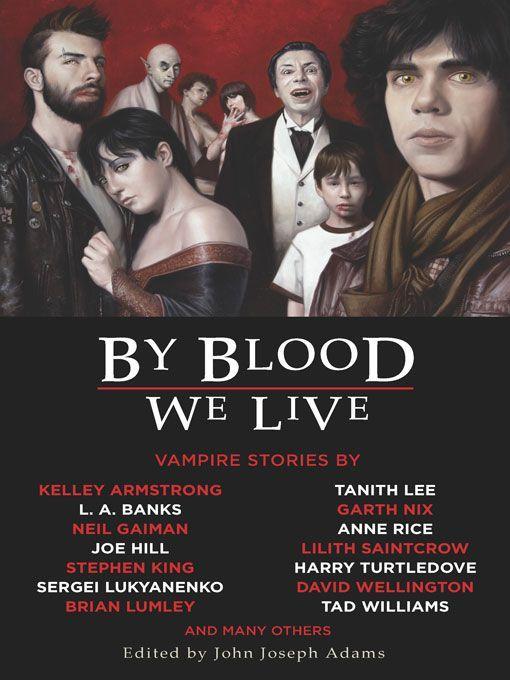
An anthology of stories edited by John Joseph Adams.
From Dracula to Buffy the Vampire Slayer; from Castlevania to Tru Blood, the romance between popular culture and vampires hearkens back to humanity’s darkest, deepest fears, flowing through our very blood, fears of death, and life, and insatiable hunger. And yet, there is an attraction, undeniable, to the vampire archetype, whether the pale European count, impeccably dressed and coldly masculine, yet strangely ambiguous, ready to sink his sharp teeth deep into his victims’ necks, draining or converting them, or the vamp, the count’s feminine counterpart, villain and victim in one, using her wiles and icy sexuality to corrupt man and woman alike… Edited by John Joseph Adams (Wastelands, The Living Dead), By Blood We Live gathers together the best vampire literature of the last three decades from many of today’s most renowned authors of fantasy, speculative fiction, and horror.
An anthology of stories edited by John Joseph Adams
From Dracula to Buffy the Vampire Slayer; from Castlevania to Tru Blood, the romance between popular culture and vampires hearkens back to humanity's darkest, deepest fears, flowing through our very blood, fears of death, and life, and insatiable hunger. And yet, there is an attraction, undeniable, to the vampire archetype, whether the pale European count, impeccably dressed and coldly masculine, yet strangely ambiguous, ready to sink his sharp teeth deep into his victims' necks, draining or converting them, or the vamp, the count's feminine counterpart, villain and victim in one, using her wiles and icy sexuality to corrupt man and woman alike… Edited by John Joseph Adams (Wastelands, The Living Dead), By Blood We Live gathers together the best vampire literature of the last three decades from many of today's most renowned authors of fantasy, speculative fiction, and horror.
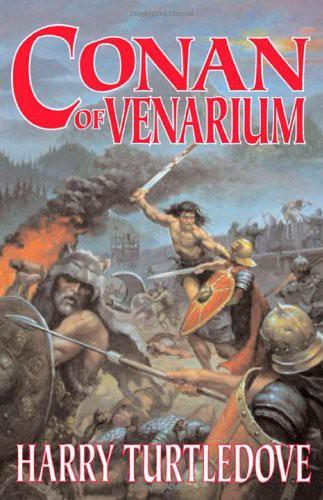
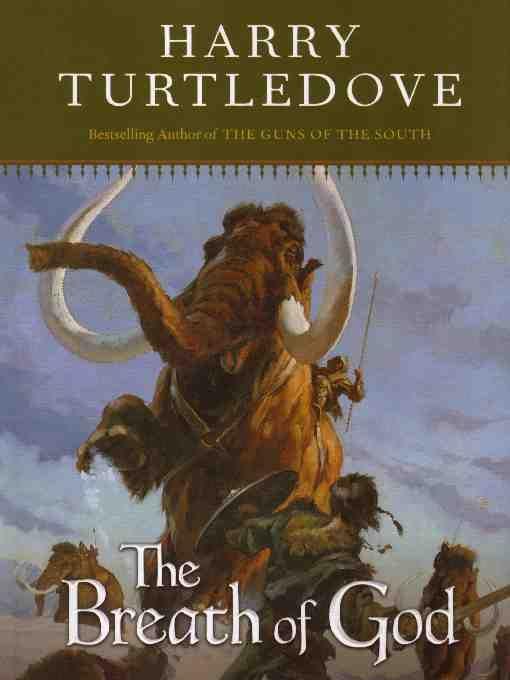
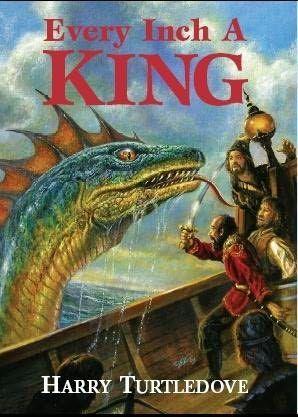
A new Conan adventure--from one of today's most popular writers of fantasy and SF!
For decades, millions of readers have thrilled to the adventures of Conan, the barbarian adventurer invented by Robert E. Howard and further chronicled by other fantasy greats, including such notables as L. Sprague de Camp, Poul Anderson, and Robert Jordan.
Now Harry Turtledove, one of today's most popular writers of fantasy and SF, contributes a novel to the Conan saga--a tale of Conan in his youth, in the year or so before he becomes the wandering adventurer we know from the tales of Howard and others.
On the verge of adulthood, he lives in a Cimmerian hamlet, caring for his ailing mother, working in his father's smithy, and casting his eye on the weaver's daughter next door.
Then war comes: an invasion by the Aquilonian Empire. Conan burns to join the fight, but he's deemed too young. Then, from the border country, comes an unbelievable report: The Aquilonians have smashed the Cimmerian defending forces, and can rule as they please. Soon their heavily garrisoned forts dot the countryside. Their settlers follow after, carving homesteads out of other men's land.
Every Cimmerian longs to drive the intruders out with fire and sword, but they must stay their hands, for the Aquilonians have promised savage reprisals. Then, intolerably, the Aquilonian commander takes a wholly dishonorable interest in the weaver's daughter -- and he's not a man to wait, or even ask permission.
It's not a recipe for a peaceable outcome.
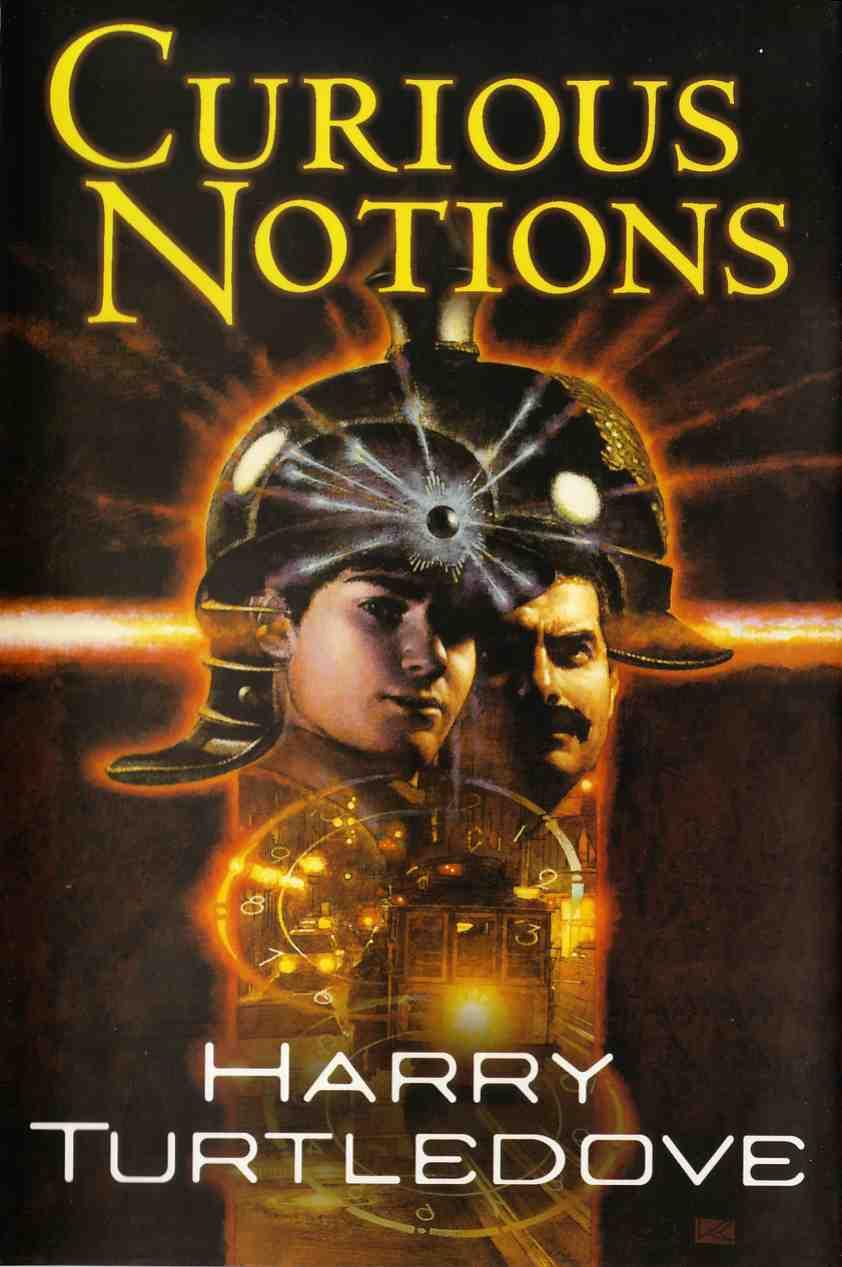
In a parallel-world 21st-century San Francisco where the Kaiser's Germany won World War One and went on to dominate the world, Paul Gomes and his father Lawrence are secret agents for our timeline, posing as traders from a foreign land. They run a storefront shop called Curious Notions, selling what is in our world routine consumer technology-record players, radios, cassette decks--all of which is better than anything in this world, but only by a bit. Their real job is to obtain raw materials for our timeline. Just as importantly, they must guard the secret of Crosstime Traffic--for of the millions of parallel timelines, this is one of the few advanced enough to use that secret against us.
Now, however, the German occupation police are harrassing them. They want to know where they're getting their mysterious goods. Under pressure, Paul and Lawrence hint that their supplies comes from San Francisco's Chinese...setting in motion a chain of intrigues that will put the entire enterprise of Crosstime Traffic at deadly risk.
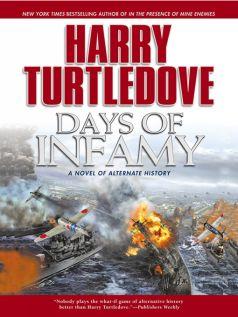
Days of Infamy is a re-imagining of the Pacific War. The major difference being that the Empire of Japan not only attacks Pearl Harbor, but follows it up with the landing and occupation of Hawaii. The logic of how the battle could have developed in Oahu, including the destruction of Halsey's fleet, is presented in detail. As is usual in Turtledove novels the action occurs from several points of view. Besides historical figures these include a corporal in the Japanese Army, a surfer (who invents the sailboard so he can fish once Honolulu is occupied), Nisei children caught between the warring cultures, prisoners of war, and others. The way that control of the islands allows Japan to dominate much of the southern Pacific Ocean is explored, and the capure of a modern (for the time) radar system in noted. There is also a reverse Battle of Midway where an invading American force is defeated. Eventually, as was common in their other occupied territories, the Japanese create a puppet government, ruling through a member of the Hawaiian Royal Family who lives in the Iolani Palace.
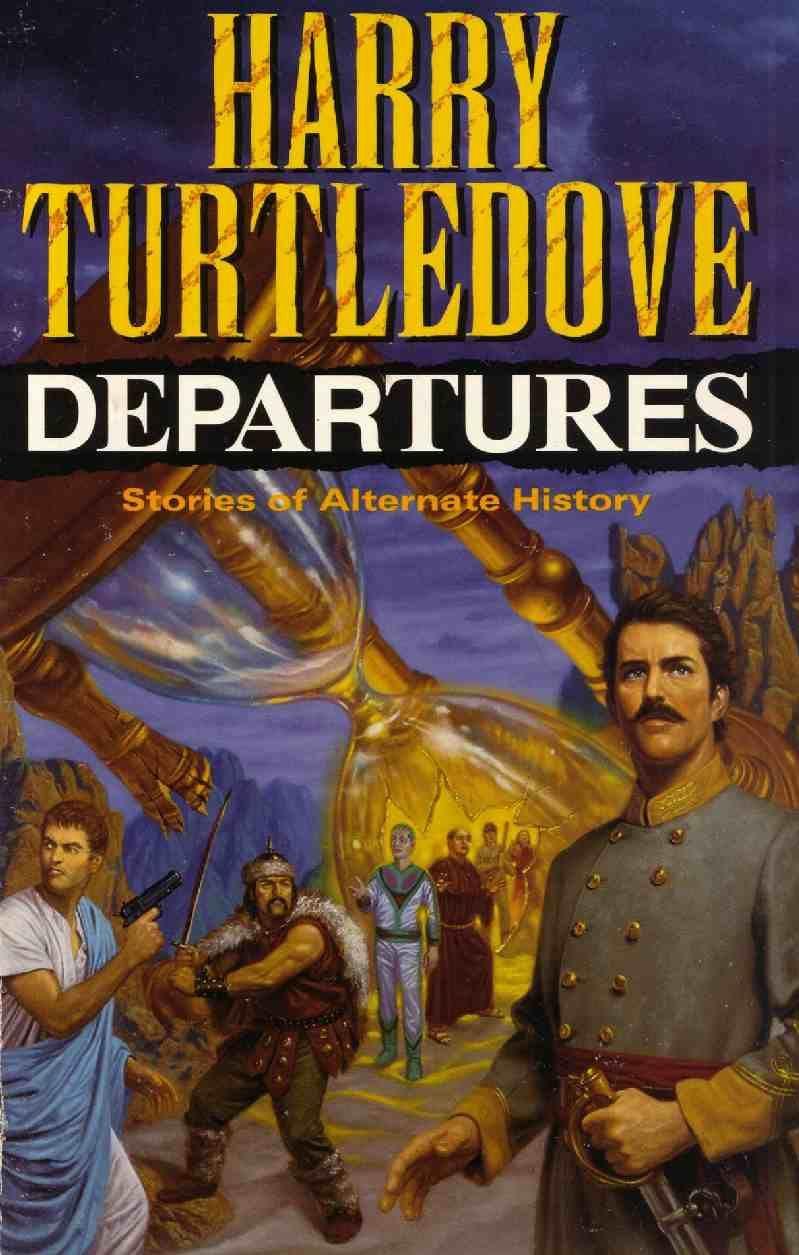
'Down in the Bottomlands' is a novella written by Harry Turtledove which takes places in an alternative history in which the Atlantic Ocean did not reflood the Mediterranean Sea 5.5 million years ago in the Miocene Epoch, as it did in our history. The Mediterranean Basin thus remains dry to the present day in this time line, as a vast sunken desert called the Bottomlands, averaging nearly two kilometers below mean sea level, with summer temperatures reaching well above 40 °C and with little or no rainfall.
Following the nuclear attack on the colonist ships in Second Contact, the Race continues to try to find the responsible nation, along with the purpose of the Lewis and Clark, a large space station launched by the United States. At the same time, the range animals brought by the Race colonists begin to spread into the human nations, causing ecological trouble and causing conflicts between them. Meanwhile, in the Soviet Union the NKVD under Lavrenti Beria attempts to launch a coup against Vyacheslav Molotov, but is thwarted by Georgi Zhukov. In Nazi Germany, Heinrich Himmler, the Fuhrer, dies and is replaced by Ernst Kaltenbrunner. Kaltenbrunner, angered by the policy of accommodation Himmler carried out towards the Race, including his refusal to invade Race-occupied Poland, causes him to initiate a nuclear war between Germany and the Race.
In 1914, the First World War ignited a brutal conflict in North America, with the United States finally defeating the Confederate States. In 1917, The Great War ended and an era of simmering hatred began, fueled by the despotism of a few and the sacrifice of many. Now it's 1942. The USA and CSA are locked in a tangle of jagged, blood-soaked battle lines, modern weaponry, desperate strategies, and the kind of violence that only the damned could conjure up—for their enemies and themselves. In Richmond, Confederate president and dictator Jake Featherston is shocked by what his own aircraft have done in Philadelphia—killing U.S. president Al Smith in a barrage of bombs. Featherston presses ahead with a secret plan carried out on the dusty plains of Texas, where a so-called detention camp hides a far more evil purpose. As the untested U.S. vice president takes over for Smith, the United States face a furious thrust by the Confederate army, pressing inexorably into Pennsylvania. But with the industrial heartland under siege, Canada in revolt, and U.S. naval ships fighting against the Japanese in the Sandwich Islands, the most dangerous place in the world may be overlooked.
The human price of war, regardless of nationality, is the relentless focus of this chilling sequel to Turtledove's alternative history Days of Infamy (2004), in which the Japanese conquer Hawaii after the attack on Pearl Harbor. Times are hard for Americans under the occupation. Scarce food and resources result in privation and a thriving black market. Japanese soldiers work POWs to death with heavy labor on insufficient rations. Women are forced into prostitution as comfort women. But the U.S. armed forces have a few tricks up their sleeve, notably a new kind of aircraft that can hold its own against the Zero. Both the Japanese and American militaries scheme, plan and train, while surfer bums, POWs and fishermen just try to get by. A plethora of characters, each with his or her own point of view, provide experiences in miniature that combine to paint a broad canvas of the titanic struggle, if at the cost of a fragmented narrative.
From Star Trek to Star Wars, from Dune to Foundation, science fiction has a rich history of exploring the idea of vast intergalactic societies, and the challenges facing those living in or trying to manage such societies. The stories in Federations will continue that tradition. What are the social/religious/environmental/technological implications of living in such a vast society? What happens when expansionist tendencies on a galactic scale come into conflict with the indigenous peoples of other planets, of other races? And what of the issue of communicating across such distances, or the problems caused by relativistic travel? These are just some of the questions and issues that the stories in Federations will take on.