 fb2
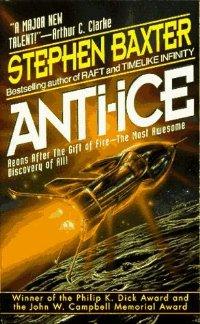
fb2The novel can be classified as an alternate history for its portrayal of 19th century Europe and the changes resulting, particularly in Britain, from an explosive scientific discovery made in the 1850s. A new element has been discovered in a hidden vein near the South Pole. Anti-ice is harmless until warmed, when it releases vast energies that promise new wonders and threaten new horrors beyond humankind’s wildest dreams.
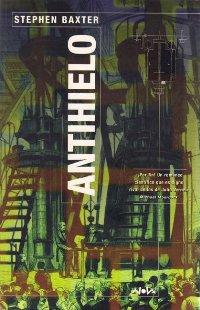
En 1870, cuando el poder del Imperio británico es absoluto, en las remotas tierras de una península antártica al sur del continente australiano se descubre un nueva material: el antihielo. Por el fenómeno que Faraday denominará de «conductancia aumentada», el material libera prodigiosas cantidades de energía cuando su temperatura se eleva. Su potencial energético, casi infinito, va a acelerar la Revolución Industrial de forma insospechada.
El antihielo, como no podía ser de otra manera, es empleado en la campaña de Crimea, pero también se revela útil en otras aventuras del espíritu humano que, a priori, parecen menos. sangrientas. En la Nueva Gran Exposición de Manchester de 1870, un joven agregado del Foreing Office descubrirá el inmenso poder del antihielo y, junto al visionario sir Josiah Traveller, tendrá que enfrentarse a un inesperado y decimonónico viaje espacial a la Luna.
Stephen Baxter, la nueva y gran estrella de la ciencia ficción británica, es considerado el sucesor de Arthur C. Clarke y un igual de Isaac Asimov y Robert A. Heinlein. Sus homenajes a Herbert G. Wells (Las naves del tiempo) y a Julio Verne (Antihielo) son un verdadero tour de force de la mejor ciencia ficción.
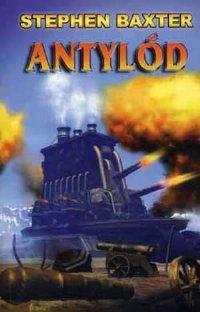
S. Baxter z talentem dorównującym najznakomitszym przebłyskom geniuszu J. Verne’a opisuje świat, w którym wielkie mosty spinają Kontynent z Wielką Brytanią, błyszczące jednotorowe koleje przewożą błyskawicznie pasażerów na olbrzymie odległości, a przerażony świat wstrzymuje oddech w przededniu wojny prowadzonej za pomocą substancji o niebywałych właściwościach — antylodu. Autor przechodzi od odległej przyszłości, opisywanej w poprzednich dziełach, do niedawnej przeszłości, nie tracąc nic ze swej pomysłowości i błyskotliwości. Umiejętnie portretuje świat dyplomatycznych zabiegów, romantycznej miłości i gorącej publicznej debaty nad konsekwencjami ludzkiego panowania nad siłami natury.

Bisesę Dutt, odesłaną na Ziemię 2037 roku przez tajemniczych i potężnych Pierworodnych, prześladują wspomnienia pięciu lat spędzonych na dziwnej, odmienionej Ziemi o nazwie Mir, światem poskładanym z lądów i ludzi wyrwanych z rozmaitych epok historii Ziemi. Dlaczego Pierworodni utworzyli Mir? Dlaczego Bisesę tam zabrano, a następnie sprowadzono z powrotem zaledwie w dzień po jej zniknięciu?
Pytania, jakie zadaje sobie Bisesa, znajdą odpowiedź w chwili odkrycia przez naukowców niezwykłej anomalii w jądrze Słońca, będącej dowodem interwencji obcych ponad dwa tysiące lat wcześniej. Plan nakreślony przez zagadkowych obserwatorów oddalonych o wiele lat świetlnych ma zostać zrealizowany w postaci burzy słonecznej, której celem jest likwidacja życia na Ziemi. Kiedy nad światem zawisa widmo apokalipsy, okazuje się, że różnice polityczne i religijne na Ziemi zagrażają wszelkim próbom ratowania planety. A Pierworodni przez cały czas obserwują…
Baxter connects the lives of George Poole in the present and Regina at the end of the Roman empire. George’s father has just died, and the picture of a girl, Rosa, comes to light in his effects. Rosa is the mysterious twin George never knew, and he becomes consumed with the desire to find her. Regina’s part of the story begins in Britain at the end of Roman rule and takes her through the western empire’s collapse to Rome itself. Back to the near-past: George’s sister, it develops, had been sent to the Order of Mary, Queen of Virgins, which has existed, hive-like, in Rome since the time of Regina, one of its founders. George is Regina’s descendant, and the order being rather a family affair, George arrives at many uncomfortable realizations as he learns more about it. Opening with an artificial anomaly discovered in the Kuiper Belt beyond Neptune and ending with disturbing extrapolation of humanity’s future, Coalescent is a fabric of many slowly developed plot threads woven into a tight tapestry.



Michael Poole spędził wiele lat, zmagając się z problemem fizyki kwantowej podczas budowy niezwykłego tunelu czasoprzestrzennego, łączącego teraźniejsze, przeszłe i przyszłe światy. Kontynuując samotnie swe badania w Chmurze Oorta, Michael nie wie, że jego odkrycia są wykorzystywane przez buntowników z przyszłości odległej o tysiąc pięćset lat. Fantyczna grupa Przyjaciół Wignera ucieka w przeszłość sprzed okresu, w którym Ziemia jest okupowana przez tajemniczą rasę qaxów. Dawna przyjaciółka Poole'a, utalentowany naukowiec Miriam Berg, zostaje zmuszona do współpracy z buntownikami. Przewidując katastrofalny wpływ ich działań na rozwój historii, wysyła wiadomość do Michaela z prośbą o pomoc. Qaxowie ruszają w głąb czasu z zamiarem unicestwienia ludzkości.

Michael Poole spędził wiele lat, zmagając się z problemem fizyki kwantowej podczas budowy niezwykłego tunelu czasoprzestrzennego, łączącego teraźniejsze, przeszłe i przyszłe światy. Kontynuując samotnie swe badania w Chmurze Oorta, Michael nie wie, że jego odkrycia są wykorzystywane przez buntowników z przyszłości odległej o tysiąc pięćset lat. Fantyczna grupa Przyjaciół Wignera ucieka w przeszłość sprzed okresu, w którym Ziemia jest okupowana przez tajemniczą rasę qaxów. Dawna przyjaciółka Poole'a, utalentowany naukowiec Miriam Berg, zostaje zmuszona do współpracy z buntownikami. Przewidując katastrofalny wpływ ich działań na rozwój historii, wysyła wiadomość do Michaela z prośbą o pomoc. Qaxowie ruszają w głąb czasu z zamiarem unicestwienia ludzkości.
Stellen Sie sich ein Universum vor, in dem die Schwerkraft eine Milliarde Mal stärker ist als in unserem. In dem schon der menschliche Körper eine meßbare Gravitation hat. In dem Sonnen nur ein paar Kilometer durchmessen und bereits ein Jahr nach ihrer Entstehung ausgebrannt sind. Fünfhundert Jahre nach der Havarie des Raumschiffs in diesem Universum kämpfen die Nachfahren der Besatzung ums Überleben. Sie sind in zwei Gruppen zerfallen: den Mineurs, die das eiserne Herz einer erkalteten Sonne ausschlachten, und den Wissenschaftlern, die auf dem „Floß“ leben, das sie aus den Resten des ehemaligen Raumschiffs gebaut haben. Dies ist die Geschichte des jungen Mineurs Rees, der erstaunlich begabt ist und deshalb eine Stelle als Wissenschaftsgehilfe bekommt. Er wird inne, daß ihre kleine Gesellschaft dem Untergang geweiht ist — und niemand eine Idee zu haben scheint, wie man ihn aufhalten könnte.

DAS BUCH
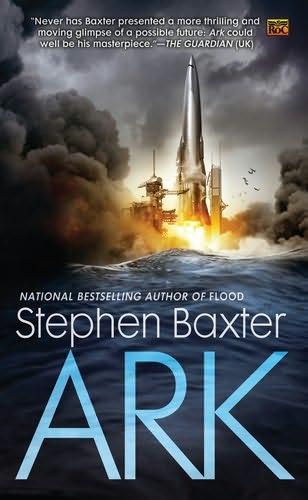
Die Erde in naher Zukunft: Eine gigantische Flutwelle hat weite Teile der Welt überschwemmt, um das verbleibende Festland werden erbitterte Kriege geführt, und der Meeresspiegel steigt immer weiter an. Um das Fortbestehen der Menschheit zu sichern, entwickeln amerikanische Wissenschaftler einen scheinbar genialen Plan: Eine kleine Gruppe Auserwählter soll sich in einem eigens dafür konstruierten Raumschiff – der »Arche« – auf den Weg machen, um in den Weiten des Universums einen neuen Planeten zu besiedeln. Der Start gelingt, und die neue Heimat rückt immer näher. Doch an ihrem Zielplaneten angekommen, müssen die Auswanderer feststellen, dass die »Erde II« für Menschen unbewohnbar ist. Und so steht die Besatzung der Arche vor einer existenziellen Entscheidung: Kehren sie auf die zerstörte Erde zurück oder setzen sie ihre Reise ins Ungewisse fort?
Nach seinem Erfolgsroman Die letzte Flut führt Stephen Baxter in Die letzte Arche auf meisterhafte Weise die Geschichte einer Menschheit fort, die von ihrem eigenen Planeten vertrieben wird.
DER AUTOR
Stephen Baxter, 1957 in Liverpool geboren, studierte Mathematik und Astronomie, bevor er sich ganz dem Schreiben widmete. Er zählt zu den international bedeutendsten Autoren wissenschaftlich orientierter Literatur. Etliche seiner Romane wurden mehrfach preisgekrönt und zu internationalen Bestsellern. Baxter lebt und arbeitet im englischen Buckinghamshire.
Weitere Informationen zu Autor und Werk erhalten Sie unter:
www.stephen-baxter.com
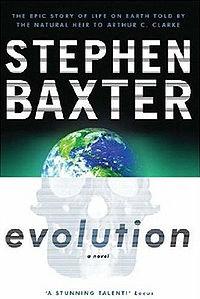
Evolution is a collection of short stories that work together to form an episodic science fiction novel. It follows 565 million years of human evolution, from shrewlike mammals 65 million years in the past to the ultimate fate of humanity (and its descendants, both biological and non-biological) 500 million years in the future.
The primary protagonist in Evolution is evolution itself (although primates as a group constitute another protagonist). The book follows the hero’s course as it shapes surviving pre-humans into tree dwellers, remoulds a group that drifts from Africa to a (then much closer) New World on a raft formed out of debris, and confronting others with a terrible dead end as ice clamps down on Antarctica.
The stream of DNA runs on elsewhere, where ape-like creatures in North Africa are forced out of their diminishing forests to come across grasslands where their distant descendants will later run joyously. At one point, hominids become sapient, and go on to develop technology, including a universal constructor machine that goes to Mars and multiplies, and in an act of global ecophagy consumes Mars by converting the planet into its descendants. Human extinction (or the extinction of human culture) also occurs in the book, as well as the end of planet Earth and the rebirth of life on another planet. (The extinction-level event that causes the human extinction is, indirectly, an eruption of the volcano Rabaul, coupled with various actions of humans themselves, some of which are only vaguely referred to, but implied to be a form of genetic engineering which removed the ability to reproduce with non-engineered humans.) Also to be found in Evolution are ponderous Romans, sapient dinosaurs, the last of the wild Neanderthals, a primate who witnesses the extinction of the dinosaurs, symbiotic primate-tree relationships, mole people, and primates who live on a Mars-like Earth.

It's the job of a science fiction writer to visualize extrapolations of the future. But there are those who go far beyond, venturing into realms of breathtaking science. That kind of cutting edge talent is as rare as a supernova-and, in its own way, just as powerful. Arthur C. Clarke had it. So did William Gibson. Now, with Evolution, Stephen Baxter delivers what is sure to be one of the most talked-about books of the year-and shows once again why he belongs among the select company of science fiction writers who matter.
Stretching from the distant past into the remote future, from primordial Earth to the stars, Evolution is a soaring symphony of struggle, extinction, and survival, a dazzling epic that combines a dozen scientific disciplines and a cast of unforgettable characters to convey the grand drama of evolution in all its awesome majesty and rigorous beauty.
Sixty-five million years ago, when dinosaurs ruled the Earth, lived a small mammal, a proto-primate of the species Purgatorius. From this humble beginning, Baxter traces the human lineage forward through time. The adventure that unfolds is a gripping odyssey governed by chance and competition, a perilous journey to an uncertain destination along a route beset by sudden and catastrophic upheavals. It is a route that ends, for most species, in stagnation or extinction. Why should humanity escape this fate?
A generation from today, a group of concerned scientists-distant descendants of that primitive Purgatorius-gathers on a remote island to discuss this very question. The ceaseless expansion of human civilization has triggered an urgent environmental crisis that must be solved now if the Earth is to survive as a place hospitable to human life. But just when a peaceful solution seems within reach, two acts of shocking violence set in motion a cataclysmic chain of events that will expose the limitations of human intellect and adaptability in the face of the blind and implacable processes of Darwin's dangerous idea.
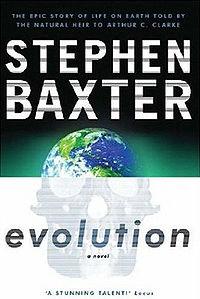
Evolution is a collection of short stories that work together to form an episodic science fiction novel. It follows 565 million years of human evolution, from shrewlike mammals 65 million years in the past to the ultimate fate of humanity (and its descendants, both biological and non-biological) 500 million years in the future.
The primary protagonist in Evolution is evolution itself (although primates as a group constitute another protagonist). The book follows the hero’s course as it shapes surviving pre-humans into tree dwellers, remoulds a group that drifts from Africa to a (then much closer) New World on a raft formed out of debris, and confronting others with a terrible dead end as ice clamps down on Antarctica.
The stream of DNA runs on elsewhere, where ape-like creatures in North Africa are forced out of their diminishing forests to come across grasslands where their distant descendants will later run joyously. At one point, hominids become sapient, and go on to develop technology, including a universal constructor machine that goes to Mars and multiplies, and in an act of global ecophagy consumes Mars by converting the planet into its descendants. Human extinction (or the extinction of human culture) also occurs in the book, as well as the end of planet Earth and the rebirth of life on another planet. (The extinction-level event that causes the human extinction is, indirectly, an eruption of the volcano Rabaul, coupled with various actions of humans themselves, some of which are only vaguely referred to, but implied to be a form of genetic engineering which removed the ability to reproduce with non-engineered humans.) Also to be found in Evolution are ponderous Romans, sapient dinosaurs, the last of the wild Neanderthals, a primate who witnesses the extinction of the dinosaurs, symbiotic primate-tree relationships, mole people, and primates who live on a Mars-like Earth.
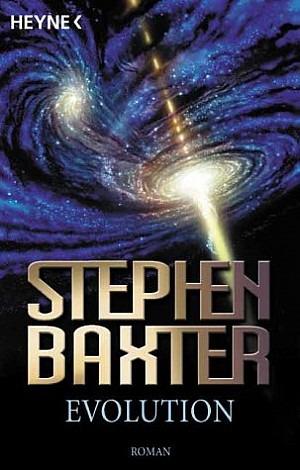
Ihre Geschichte beginnt, als Dinosaurier die Erde beherrschen. Sie überstehen den gnadenlosen Kampf mit anderen Spezies um Nahrung und Territorien. Sie überleben den Einschlag eines gigantischen Asteroiden und erben eine leere Welt. Sie folgen der langsamen Bewegung der Kontinente über die Erde. Sie errichten eine planetenumspannende Zivilisation. Und sie greifen nach den Sternen…
In diesem atemberaubenden, hochspannenden Roman folgt Stephen Baxter dem Strom der menschlichen Evolution, der Millionen von Jahren in der Vergangenheit entspringt und sich weit in die Zukunft ergießt. Ein in der Literatur einzigartiges Panorama – die gesamte Geschichte der Menschheit in einem Buch.