 fb2
fb2The acclaimed author of Eternity offers a compelling sequel to his visionary Forge of God. Earth is gone, completely destroyed by a ruthless alien. Hundreds of years away, a handful of exiles hurtles through the galaxies in a quest for revenge, armed with powers they do not understand—and determined to find and punish the killers who murdered their world.

The award winning tale of the inevitable takeover of our society by a benign, intelligent scientific experiment gone awry. In the tradition of the greatest cyberpunk novels, Blood Music explores the imminent destruction of mankind and the fear of mass destruction by technological advancements.
Blood Music follows present-day events in which the fears concerning nuclear annihilation of the world subsided after the Cold War and the fear of chemical warfare spilled over into the empty void of nuclear fear. An amazing breakthrough in genetic engineering made by Vergil Ulam is considered too dangerous for further research, but rather than destroy his work, he injects himself with his creation and walks out of his lab, unaware of just quite how his actions will change the world.
Author Greg Bear’s treatment of the traditional tale of scientific hubris is both suspenseful and a compelling portrait of a new intelligence emerging amongst us, irrevocably changing our world.
Blood Music won the Nebula and Hugo Awards in its original shorter form.

Der Biochemiker Vergil Ulam ist ein Genie seines Fachs, aber er ist ebenso risikofreudig wie sorglos. Erarbeitet in einem gentechnischen Forschungsunternehmen auf dem Gebiet der Biologik. Sein Ziel: die Herstellung »intelligenter« Zellen durch DNS-Rekombination von menschlichem Genmaterial mit dem von Einzellern. Er tut dies auf eigene Faust und ohne Genehmigung der Firmenleitung.
Der Durchbruch gelingt ihm: es ergeben sich intelligente Lymphozyten. Als das Management von seinen gefährlichen Experimenten erfährt, die Unterlagen beschlagnahmt und ihn zwingt, die gezüchteten Kulturen zu vernichten, und ihn feuert, injiziert er sich eine von ihnen in die Blutbahn. Ein paar Tage später ist er kein Mensch mehr, sondern eine überaus produktiv und fehlerfrei arbeitende biologische Struktur, die sich alles einverleibt, mit dem sie in Berührung kommt.
Die Evolution nimmt eine neue Wendung: optimal für das Leben — aber für die Menschheit das nackte Grauen.
Greg Bear’s Nebula Award–winning novel, Darwin’s Radio, painted a chilling portrait of humankind on the threshold of a radical leap in evolution—one that would alter our species forever. Now Bear continues his provocative tale of the human race confronted by an uncertain future, where “survival of the fittest” takes on astonishing and controversial new dimensions.
Eleven years have passed since SHEVA, an ancient retrovirus, was discovered in human DNA—a retrovirus that caused mutations in the human genome and heralded the arrival of a new wave of genetically enhanced humans. Now these changed children have reached adolescence… and face a world that is outraged about their very existence. For these special youths, possessed of remarkable, advanced traits that mark a major turning point in human development, are also ticking time bombs harboring hosts of viruses that could exterminate the “old” human race.
Fear and hatred of the virus children have made them a persecuted underclass, quarantined by the government in special “schools,” targeted by federally sanctioned bounty hunters, and demonized by hysterical segments of the population. But pockets of resistance have sprung up among those opposed to treating the children like dangerous diseases—and who fear the worst if the government’s draconian measures are carried to their extreme.
Scientists Kaye Lang and Mitch Rafelson are part of this small but determined minority. Once at the forefront of the discovery and study of the SHEVA outbreak, they now live as virtual exiles in the Virginia suburbs with their daughter, Stella—a bright, inquisitive virus child who is quickly maturing, straining to break free of the protective world her parents have built around her, and eager to seek out others of her kind.
But for all their precautions, Kaye, Mitch, and Stella have not slipped below the government’s radar. The agencies fanatically devoted to segregating and controlling the new-breed children monitor their every move—watching and waiting for the opportunity to strike the next blow in their escalating war to preserve “humankind” at any cost.
Greg Bear’s Nebula Award–winning novel, Darwin’s Radio, painted a chilling portrait of humankind on the threshold of a radical leap in evolution—one that would alter our species forever. Now Bear continues his provocative tale of the human race confronted by an uncertain future, where “survival of the fittest” takes on astonishing and controversial new dimensions.
Eleven years have passed since SHEVA, an ancient retrovirus, was discovered in human DNA—a retrovirus that caused mutations in the human genome and heralded the arrival of a new wave of genetically enhanced humans. Now these changed children have reached adolescence… and face a world that is outraged about their very existence. For these special youths, possessed of remarkable, advanced traits that mark a major turning point in human development, are also ticking time bombs harboring hosts of viruses that could exterminate the “old” human race.
Fear and hatred of the virus children have made them a persecuted underclass, quarantined by the government in special “schools,” targeted by federally sanctioned bounty hunters, and demonized by hysterical segments of the population. But pockets of resistance have sprung up among those opposed to treating the children like dangerous diseases—and who fear the worst if the government’s draconian measures are carried to their extreme.
Scientists Kaye Lang and Mitch Rafelson are part of this small but determined minority. Once at the forefront of the discovery and study of the SHEVA outbreak, they now live as virtual exiles in the Virginia suburbs with their daughter, Stella—a bright, inquisitive virus child who is quickly maturing, straining to break free of the protective world her parents have built around her, and eager to seek out others of her kind.
But for all their precautions, Kaye, Mitch, and Stella have not slipped below the government’s radar. The agencies fanatically devoted to segregating and controlling the new-breed children monitor their every move—watching and waiting for the opportunity to strike the next blow in their escalating war to preserve “humankind” at any cost.

Is evolution a gradual process, as Darwin believed, or can change occur suddenly, in an incredibly brief time span, as has been suggested by Stephen J. Gould and others? Greg Bear takes on one of the hottest topics in science today in this riveting, near-future thriller. Discredited anthropologist Mitch Rafelson has made an astonishing discovery in a recently uncovered ice cave in the Alps. At he mummified remains of a Neanderthal couple and their newborn, strangely abnormal child. Kaye Lang, a molecular biologist specializing in retroviruses, has unearthed chilling evidence that so-called junk DNA may have a previously unguessed-at purpose in the scheme of life. Christopher Dicken, a virus hunter at the National Center for Infectious Diseases in Atlanta, is hot in pursuit of a mysterious illness, dubbed Herod’s flu, which seems to strike only expectant mothers and their fetuses. Gradually, as the three scientists pool their results, it becomes clear that Homo sapiens is about to face its greatest crisis, a challenge that has slept within our genes since before the dawn of humankind. Bear is one of the modern masters of hard SF, and this story marks a return to the kind of cutting-edge speculation that made his Blood Music one of the genre’s all-time classics. Centered on well-developed, highly believable figures who are working scientists and full-fledged human beings, this fine novel is sure to please anyone who appreciates literate, state-of-the-art SF.
Won Nebula Award for Best Novel in 2000.
Nominated for Hugo, Locus and Campbell awards in 2000.

Ein Massengrab in Georgien, in dem die Leichen mehrerer schwangerer Frauen entdeckt werden — und eine Verschwörung mit dem Ziel, diesen Fund der Öffentlichkeit vorzuenthalten …
Eine aufregende Entdeckung hoch in den Alpen: die gut erhaltenen Körper einer prähistorischen Familie — mit einem Neugeborenen, das verwir-rende biologische Merkmale aufweist …
Eine rätselhafte, epidemisch um sich greifende Krankheit, die nur werdende Mütter befällt und zunächst zu Fehlgeburten führt …
In der menschlichen DNA sind uralte Krankheiten verschlüsselt, die wie schlafende Drachen nur darauf warten, wieder zum Leben erweckt zu werden — so die umstrittene Theorie der Molekularbiologin Kaye Lang.
Nun scheinen ihre Vorstellungen tatsächlich erschreckende Realität zu werden. Denn der »Virusjäger« Christopher Dicken vom nationalen Ge-sundheitszentrum hat die Spur einer merkwürdigen, grippeartigen Erkrankung aufgenommen, die epidemisch um sich greift und unter den werdenden Müttern des Landes und ihrem Nachwuchs eine Katastrophe anzurichten droht. Dann offenbart eine erstaunliche Entdeckung hoch in den Alpen — die erhaltenen Körper einer prähistorischen Familie — eine schockierende Verbindung: Etwas, das Millionen von Jahren in unseren Genen geschlummert hat, ist erwacht.
Der Ausbruch der furchtbaren Krankheit weitet sich zu einer tödlichen Epidemie aus. In der Bevölkerung machen sich Angst und Unruhe breit; die Regierung beschließt Notstandsmaßnahmen. In einem Wettkampf mit der Zeit versuchen Dicken und Lang die Teile eines Puzzles zusammenzufügen, das nur sie zu lösen vermögen — eines evolutionären Puzzles, das die Zukunft der Menschheit bestimmen wird … wenn es überhaupt eine Zukunft gibt.
This book is an anthology of original stories inspired by science and scientists. The authors—some of the best and most decorated in the field—each visited Microsoft Research and met with top researchers in areas such as machine learning, computer vision, speech recognition, programming languages, and operating systems. They were given a unique opportunity to see new technologies under development and understand how researchers think and work.
The stories that came out of this process are the kind of science fiction that excited me as boy. They draw upon, highlight, and extrapolate current science. A number of them put scientists and engineers front and center in the narrative.
A starship hurtles through the emptiness of space. Its destination—unknown. Its purpose—a mystery.
Now, one man wakes up. Ripped from a dream of a new home—a new planet and the woman he was meant to love in his arms—he finds himself wet, naked, and freezing to death. The dark halls are full of monsters but trusting other survivors he meets might be the greater danger.
All he has are questions— Who is he? Where are they going? What happened to the dream of a new life? What happened to Hull 03?
All will be answered, if he can survive the ship.
HULL ZERO THREE is an edge-of-your-seat thrill ride through the darkest reaches of space.
Au fond d’une caverne des Alpes suisses, trois corps préservés par le froid depuis plus de dix mille ans : une famille préhistorique, néandertalienne, dont l’enfant semble curieusement moderne…
Découverte en Géorgie d’un charnier récent qui ne doit rien à la révolution ni à la guerre… Toutes les femmes étaient enceintes. Et le secret d’État pèse sur cette affaire.
Kaye Lang, généticienne de talent et peut-être de génie, découvre que la partie silencieuse de nos gènes recèle d’anciens virus susceptibles de s’éveiller. Et plus encore qu’une surprenante machinerie, enfouie dans nos gènes depuis des millions d’années, vient de s’enclencher.
Alors qu’une maladie terrifiante, le syndrome de SHEVA, se met à frapper les femmes.
L’humanité est-elle menacée, ou bien se prépare-t-elle à un nouveau bond sur l’échelle de Darwin, la voie de l’évolution ?
Vint le jour où la jeune République martienne voulut prendre son indépendance contre la volonté d’une Terre au faîte de sa puissance. Dans cette page d’histoire, Casseia Majumdar, étudiante rebelle, puis condamnée pour haute trahison, réhabilitée, élue Présidente de Mars, devait jouer un rôle déterminant. Voici le journal, complet et inexpurgé, de l’une des héroïnes les plus controversées de l’histoire de Mars et de tout le Système solaire, qui rapporte comment Mars prit son envol. Bien au-delà des limites du Système solaire…
Vergil Ulam, brillante ricercatore dei Genetron Labs, sta lavorando segretamente ad un esperimento che promette risultati sensazionali, e cioè la produzione di nuclei intelligenti di materia cellulare, capaci di evolversi e di apprendere con straordinaria rapidità. Ma quando Ulam infrange le norme di sicurezza del laboratorio e viene licenziato, si rifiuta di distruggere il frutto delle sue ricerche, come gli è stato ordinato, e decide invece di iniettarsi nel sangue le colonie cellulari, e diventare così egli stesso la cavia di un nuovo straordinario esperimento. Ma sarà il primo di un incredibile processo di mutazione e trasformazione, i cui limiti non sono facilmente immaginabili, perché infatti è subito chiaro che questa forma di intelligenza virale può assorbire e riplasmare qualsiasi materia vivente. Un’epidemia assolutamente inattaccabile, un vero e proprio universo di miliardi di cellule senzienti in frenetica espansione, che lentamente inghiottono l’America del Nord, trasformandola in uno scenario “alieno” che suscita al tempo stesso orrore e meraviglia. Ma si può parlare di catastrofe? O non è piuttosto un nuovo gradino nella scala dell’evoluzione? E che ne sarà dell’umanità, letteralmente trasfigurata da questi microscopici organismi che rappresentano una nuova dimensione di ciò che si può concepire come “vita”?
Nominato per il premio Nebula in 1985.
Nominato per i premi Hugo, Campbell e BSFA in 1976.
26 de junio de 1996: Europa, la sexta luna de Júpiter, desaparece repentinamente de los cielos, sin dejar tras de sí la menor huella de su existencia. 28 de septiembre de 1996: en el Valle de la Muerte, en California, en pleno corazón de los Estados Unidos, aparece un cono de escoria volcánica que no se halla registrado en ningún mapa geológico de la zona, y a su lado es hallada una criatura alienígena que transmite un inquietante mensaje: “Traigo malas noticias: la Tierra va a ser destruida…”
1 de octubre de 1996: el gobierno australiano anuncia que una enorme montaña de granito, un duplicado casi perfecto de Ayers Rock, ha aparecido de pronto en el Gran Desierto Victoria; junto a ella, tres resplandecientes robots de acero traen consigo un mensaje de paz y amistad…
Así se inicia una de las más apasionantes novelas de ciencia ficción de los últimos tiempos, que combina sabiamente el interés científico, la alta política internacional y la amenaza de una invasión alienígena, para ofrecernos una obra apasionante con una profundidad temática raras veces alcanzada, que se lee de un tirón hasta la última página.
La Radio de Darwin es una intrigante especulación a partir de los actuales conocimientos biológicos y antropológicos, además de un ingenioso y bien tramado thriller que cuestiona casi todas nuestras creencias sobre los origenes del ser humano y su posible destino.
Tres hechos, que al principio parecen no estar relacionados, acabarán convergiendo para sugerir una novedad devastadora y sacudir los cimientos de la ciencia: la conspiración para ocultar los cadáveres de dos mujeres y sus hijos en Rusia, el descubrimiento inesperado en los Alpes de los cuerpos congelados de una familia prehistórica, y una misteriosa enfermedad que sólo afecta a mujeres gestantes e interrumpe sus embarazos.
Kaye Lang, una biológa molecular especialista en retrovirus, y Christopher Dicken, epidemiólogo del Servicio de inteligencia de Epidemias, temen que algo ha permanecido dormido en nuestros genes durante millones de años haya empezdo a despertar. Ellos dos junto al antropólogo Mictch Rafaelson, parecen ser los únicos capaces de resolver un rompecabezas evolutivo que puede determinar el futuro de la especie humana... si ese futuro sigue existiendo.
El premio Nebula, el equivalente en ciencia ficción al Oscar cinematográfico, avala el interés de esta obra, el más sugestivo thriller sobre la investigación genética y el futuro de la especie humana. Cinco premios Nebula, dos premios Hugo, el premio Apollo de Francia y el premio Ignotus en España garantizan la alta calidad e interés de la obra del brillante autor de Marte se mueve y Fundación y caos.
Premio Nebula 2000.
Novela Finalista del Premio Hugo 2000.

In an America driven to near bankruptcy with crushing foreign debt, the Talos Corporation stands out as a major success story – training soldiers and security forces from around the world and providing logistics and troops for nearly all branches of the United States government. But Talos has another plan in mind – the destruction of the federal system and constitutional law.
Three FBI agents are all that stands between Talos's CEO Axel Price and the subversion of our nation. Fouad Al-Husam is working undercover in Lion City, Texas, on the Talos Campus – but he may have just overplayed his hand. Agent William Griffin will engage in a desperate diversion to try to rescue Al-Husam, and the top-secret information he literally carries in his blood.
Rebecca Rose is called into action to partner with an unlikely hero: Nathan Trace, one of a team of four who created and programmed the thinking machines that are about to help Axel Price in his plans for domination. Trace and his colleagues were caught up in a violent incident in the Middle East several years ago, and experienced Post-Traumatic Stress disorder. All of them were forcibly enrolled in a treatment program sponsored by Talos Corporation, code-named Mariposa – which supposedly cured their PTSD. But now they are beginning to notice unexpected side effects. The Mariposa subjects are being liberated from nearly all human emotions and concerns – and all mental limits – to become brilliant sociopaths. They are out of control and they must die.
A brilliant physicist and the daughter of one of Mars’ oldest colonizing families — both involved in the student uprising of 2171 — see the revolution take a dramatic, unexpected turn.
Won Nebula Award for Best Novel in 1994.
Nominated for Hugo, Locus, and John F. Campbell Memorial Awards in 1994.

Vergil Ulam era el genio del proyecto biológico. La reestructuración de las células. Células capaces de pensar. Cuando Genetron canceló el proyecto, Vergil sacó el trabajo de su vida fuera del laboratorio del único modo que podía: Inyectándose el mismo con ellas. Al principio, los efectos de los linfocitos inteligentes se redujeron a pequeños milagros, su vista , su estado general de salud, incluso su vida sexual, mejoraron. Pero ahora, algo extraño está ocurriendo. La trama celular de Vergil está capacitada para formar organismos complejos e incluso sociedades completas en su sangre y en su cuerpo. Vergil lleva consigo un universo. Un universo de células.

Vergil Ulam był geniuszem przekraczającym granice biologii. Pracował nad restrukturyzacją komórek ludzkiego organizmu. Komórek myślących. Ponieważ Genotron, firma, w której pracował, skasował jego rewolucyjny program badawczy, Vergil postanowił na przekór wszystkiemu ocalić dzieło swego życia. Wybrał sposób najprostszy i najskuteczniejszy — przemycił myślące komórki we własnej krwi. Początkowo skutki działania inteligentnych limfocytów są niczym cuda w małej skali: wzrok Vergila poprawia się, a on sam staje się okazem zdrowia i seksualnej sprawności. Ale potem dzieją się rzeczy bardziej niezwykłe. Komórki mnożą się i przebudowują stopniowo „te zwykłe”, tworząc organizmy o wysokim stopniu komplikacji i wręcz społeczeństwa. Vergil Ulam staje się wszechświatem. Wszechświatem składających i eksperymentujących. Komórek, które bardzo szybko odkrywają istnienie innych ludzi i „zewnętrznego” wszechświata. Komórek, które postanowiły, że oto nastał czas przemian…
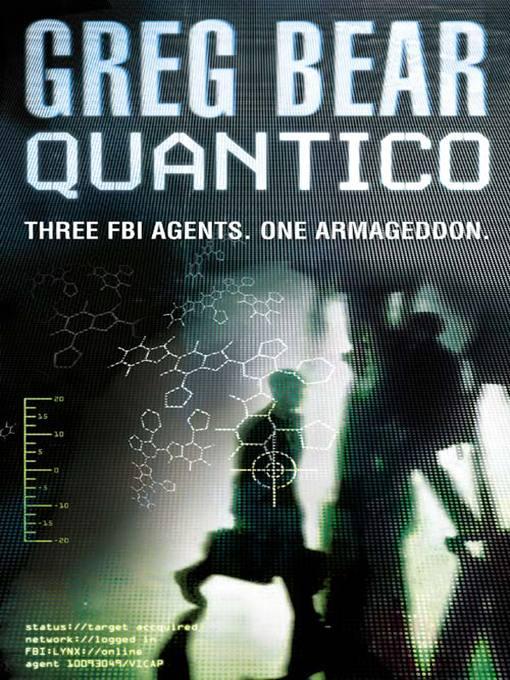
A near-future thriller that pits young FBI agents against a brilliant, homegrown terrorist.
It's the second decade of the twenty-first century, and terrorism has escalated almost beyond control. The Dome of the Rock in Jerusalem has been blown to bits by extremists and, in retaliation, thousands have died in another major attack on the United States. New weapons are being spawned in remote basement labs. No one feels safe.
In North America, the FBI uses cutting-edge technology to thwart domestic terrorists. Sat-linked engine blockers stop drug-traffickers cold; devices the size of Magic Markers test for bio-hazards on the spot; 3-D projectors reconstruct crime scenes from hours-old evidence; and sophisticated bomb suits protect against all but the most savage forces. Despite all this, the War on Terror has reached a deadly stalemate.
Now the FBI has been dispatched to deal with a new menace. Like the Anthrax threat of 2001, a plague targeted to ethnic groups-Jews or Muslims or both-has the potential to wipe out entire populations. But the FBI itself is under political assault. There's a good chance agents William Griffin, Fouad Al-Husam, and Jane Rowland will be part of the last class at Quantico. As the young agents hunt a brilliant homegrown terrorist, they join forces with veteran bio-terror expert Rebecca Rose. But the plot they uncover-and the man they chase-proves far more complex than anyone expects.