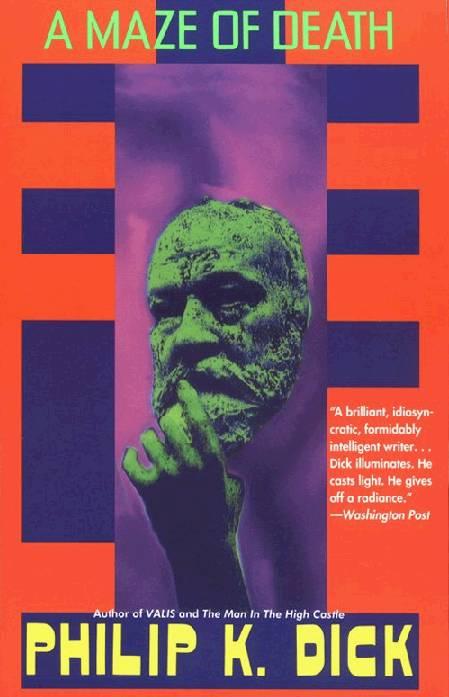
A Maze of Death
Fourteen strangers came to Delmak-O. Thirteen of them were transferred by the usual authorities. One got there by praying. But once they arrived on that planet whose very atmosphere seemed to induce paranoia and psychosis, the newcomers found that even prayer was useless. For on Delmak-O, God is either absent or intent on destroying His creations.
|
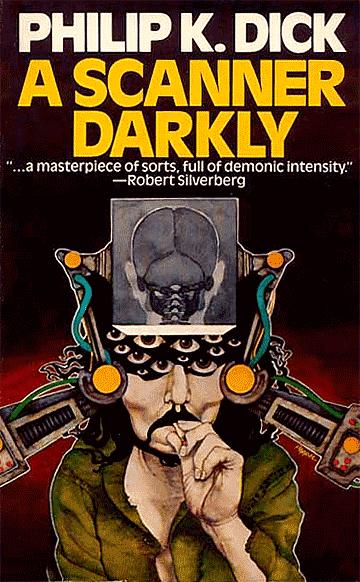
A Scanner Darkly
British Science Fiction Award (1978)Bob Arctor is a dealer of the lethally addictive drug Substance D. Fred is the police agent assigned to tail and eventually bust him. To do so, Fred takes on the identity of a drug dealer named Bob Arctor. And since Substance D—which Arctor takes in massive doses—gradually splits the user’s brain into two distinct, combative entities, Fred doesn’t realize he is narcing on himself.
|
Beyond Lies the Wub
The slovenly wub might well have said: Many men talk like philosophers and live like fools.
|
Beyond the Door
Larry Thomas bought a cuckoo clock for his wife—without knowing the price he would have to pay.
|
Confessions of a Crap Artist
Confessions of a Crap Artist is one of Philip K. Dick’s weirdest and most accomplished novels. Jack Isidore is a crap artist—a collector of crackpot ideas (among other things, he believes that the earth is hallow and that sunlight has weight) and worthless objects, a man so grossly unequipped for real life that his sister and brother-in-law feel compelled to rescue him from it. But seen through Jack’s murderously innocent gaze, Charlie and Juddy Hume prove to be just as sealed off from reality, in thrall to obsessions that are slightly more acceptable than Jack’s, but a great deal uglier.
|
Deus Irae
In the years following World War III, a new and powerful faith has arisen from a scorched and poisoned Earth, a faith that embraces the architect of world wide devastation. The Servants of Wrath have deified Carlton Lufteufel and re-christened him the Deus Irae. In the small community of Charlottesville, Utah, Tibor McMasters, born without arms or legs, has, through an array of prostheses, established a far-reaching reputation as an inspired painter. When the new church commissions a grand mural depicting the Deus Irae, it falls upon Tibor to make a treacherous journey to find the man, to find the god, and capture his terrible visage for posterity.
|
Die besten Stories
Titel der Originalausgabe: The Best of Philip K. Dick Aus dem Amerikanischen von Rainer Zubeil Copyrigt © 1977 by Philip K Dick Copyright © der deutschen Übersetzung 1981 by Moewig Verlag, München Vorwort: © 1977 by Brunner Facts and Fiction Ltd.BEYOND LIES THE WUB © 1952 by Love Romances Publishing Company, Inc. für Planet Stories SECOND VARIETY © 1953 by Space Publications, Inc. für Space Science Fiction IMPOSTOR © 1953 by Street & Smith Publications, Inc. für Astounding Science Fiction COLONY © 1953 by Galaxy Publishing Corporation für Galaxy Science Fiction EXPENDABLE © 1953 by Fantasy House, Inc. für The Magazin of Fantasy and Science Fiction FOSTER, YOU'REDEAD © 1954 by Ballantine Books, Inc. für Star Science Fiction Stories Nr. 3 THE FATHER-THING © 1954 by Fantasy House, Inc. für The Magazine of Fantasy and Science Fiction SERVICE CALL © 1955 by Columbia Publications, Inc. für Science Fiction Stories AUTOFAC © 1955 by Galaxy Publishing Corporation für Galaxy Science Fiction HUMAN IS © 1955 by Better Publications, Inc. für Startling Stories OH, TO BE A BLOBEL © 1964 by Galaxy Publishing Corporation für Galaxy Magazine FAITH OF OUR FATHERS © 1967 by Harlan Ellison für Dangerous Visions THE ELECTRIC ANT © 1969 by Mercury Press, Inc. für The Magazine of Fantasy and Science Fiction |
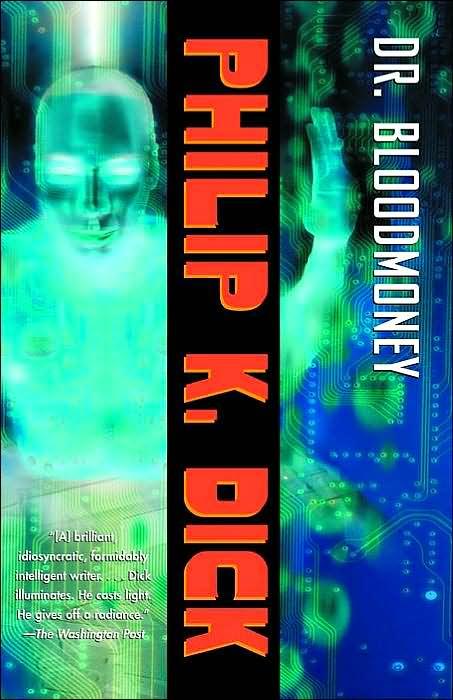
Dr. Bloodmoney, or How We Got Along after the Bomb
“Dr. Bloodmoney” is a post-nuclear-holocaust masterpiece filled with a host of Dick’s most memorable characters: Hoppy Harrington, a deformed mutant with telekinetic powers; Walt Dangerfield, a selfless disc jockey stranded in a satellite circling the globe; Dr. Bluthgeld, the megalomaniac physicist largely responsible for the decimated state of the world; and Stuart McConchie and Bonnie Keller, two unremarkable people bent the survival of goodness in a world devastated by evil. Epic and alluring, this brilliant novel is a mesmerizing depiction of Dick’s undying hope in humanity.
|
Exhibit Piece
|
Fair Game
|
Flow My Tears, the Policeman Said
On October 11 the television star Jason Taverner is so famous that 30 million viewers eagerly watch his prime-time show. On October 12 Jason Taverner is not a has-been but a never-was—a man who has lost not only his audience but all proof of his existence. And in the claustrophobic betrayal state of “Flow My Tears, the Policeman Said”, loss of proof is synonyms with loss of life.Taverner races to solve the riddle of his disappearance, immerses us in a horribly plausible Philip K. Dick United States in which everyone—from a waiflike forger of identity cards to a surgically altered pleasure—informs on everyone else, a world in which omniscient police have something to hide. His bleakly beautiful novel bores into the deepest bedrock self and plants a stick of dynamite at its center.
|
Foster, You’re Dead
|
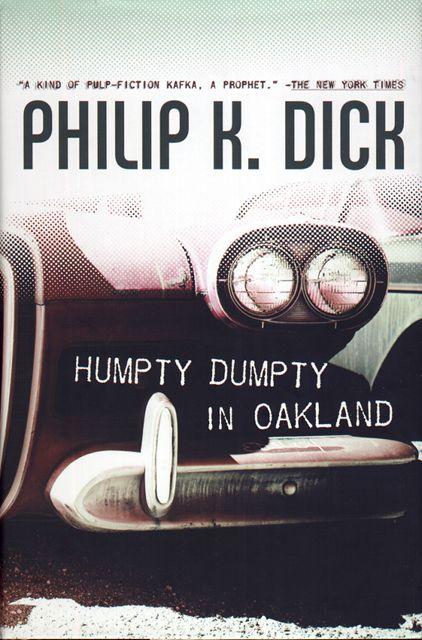
Humpty Dumpty in Oakland
Al Miller is a sad case, someone who can’t seem to lift himself up from his stagnant and disappointing life. He’s a self-proclaimed nobody, a used car salesman with a lot full of junkers.His elderly landlord, Jim Fergesson, has decided to retire because of a heart condition and has just cashed in on his property, which includes his garage, and, next to it, the lot that Al rents. This leaves Al wondering what his next step should be, and if he even cares.Chris Harman is a record-company owner who has relied on Fergesson’s to fix his Cadillac for many years. When he hears about Fergesson’s sudden retirement fund, he tells him about a new realty development and urges him to invest in it. According to Harman, it’s a surefire path to easy wealth. Fergesson is swayed. This is his chance to be a real businessman, a well-to-do, respected gentleman, like Harman.But Al is convinced that Harman is a crook out to fleece Fergesson. Even if he doesn’t particularly like Fergesson, Al is not going to stand by and watch him get cheated. Only Al’s not very good at this, either. He may not even be right.
|
James P. Crow
It was a robots' world, run by soul-less heaps of haughty metal. But among the miserable band of humans, there was one who aspired to greatness; one who aimed to bust out of his subservient shell. He was the Time-Window-Kid ... he was ...
|
Marsianischer Zeitsturz
Das BuchMit großem Enthusiasmus und Pioniergeist haben die Menschen den Mars besiedelt. Doch nun, Jahre später, ähnelt das Leben dort auf erschreckende Weise dem Alltagstreiben auf der Erde. Und auch die politischen Grabenkämpfe setzen sich nahtlos fort: Arnie Kott ist bereits der mächtigste Mann auf dem Mars, aber das ist ihm nicht genug. Mittels eines geistesgestörten Jungen, für den die Schranken der Zeit nicht existieren, will er seinen Feinden eine endgültige Niederlage beibringen. Doch der Junge ist nicht nur in der Lage, vorwärts und rückwärts durch die Zeit zu stürzen, er kann Vergangenheit und Zukunft auch nach den Vorstellungen seines umnachteten Gehirns umgestalten. Die gewohnte Ordnung der 0.00cm Dinge zerfällt, Raum und Zeit lösen sich auf. Und der Traum vom Pionierleben wandelt sich endgültig zum Alptraum ...»Philip K. Dick ist ein visionärer und zugleich naiver (im guten Sinne des Wortes) Science-Fiction-Maler. Er ist ein Bosch im Fell eines Holzschnitzers, ein Goya, der mit der Schminke und dem Rouge einer Theatergarderobe aus der Provinz arbeitet.«- Stanislaw Lem»Das ist nicht nur ein geniales Buch in bester Philip-K.-Dick-Manier, sondern auch einer der hervorragendsten Mars-Romane, die je geschrieben wurden. So wie Dick es schildert, könnte es eines Tages wirklich sein.«- Kim Stanley RobinsonDer AutorPhilip K. Dick, 1928 in Chicago geboren, schrieb schon in jungen Jahren zahllose Stories und arbeitete als Verkäufer in einem Plattenladen in Berkeley, ehe er 1952 hauptberuflich Schriftsteller wurde. Er verfaßte über hundert Erzählungen und Kurzgeschichten für diverse Magazine und Anthologien und schrieb mehr als dreißig Romane, von denen etliche heute als Klassiker der amerikanischen Literatur gelten. Philip K. Dick starb am 2. März 1982 in Santa Ana, Kalifornien, an den Folgen eines Schlaganfalls.
|
Martian Time-Slip
Warning: Although this the action of this book is set on Mars, it could just as easily have taken place in one of the desert communities around Los Angeles. The real action takes place inside the minds of the characters. If you're looking for all the external trappings of interplanetary Sci-Fi, you will be deeply disappointed. Approach it with an open mind, and you will be richly rewarded. What happens when one of the most powerful men on the planet Mars finds that real-estate speculators are intent on gobbling up the remote and seemingly worthless Franklin D Roosevelt mountains? Naturally he wants to find out why. A casual conversation with a psychologist followed by a chance encounter with a master repairman leads to one of those Dickian leaps: Since (1) autistic children do not respond to others because they are living in the future, (2) just build a machine to slow down time and (3) maybe even use it to go back in time and retroactively post a claim on the land before the speculators do. Well, the mechanism works, in a way. The speculators were proposing to build giant apartment blocks to help relieve overcrowding on polluted Earth. The autistic boy, Manfred Steiner, sees much further, however, to the time the apartment block would become a warehouse for the sick and dying, a "tomb world," of which he himself is a denizen. Manfred's visions have a way of bending the reality of those around him; he persistently retreats to a vision of reality as "gubble" -- entropy seen as large wormlike constructs that underlie reality, leading to pure "gubbish." MARTIAN TIME-SLIP is one of my favorite Philip K Dicks. (The problem is that I like all 15 or so I've read more or less equally.) Reading Philip K Dick tends to bend your sense of reality much as Manfred Steiner does. And one can't help looking over one's shoulder for a few hours after reading him. I see Dick as not so much a science fiction writer as a creator of disturbing and eerily plausible futures.
|
Meddler
|
Mr. Spaceship
A human brain-controlled spacecraft would mean mechanical perfection. This was accomplished, and something unforeseen: a strange entity called—
|
Nanny
|
Piper in the Woods
Earth maintained an important garrison on Asteroid Y-3. Now suddenly it was imperiled with a biological impossibility—men becoming plants!
|