A Song for Arbonne
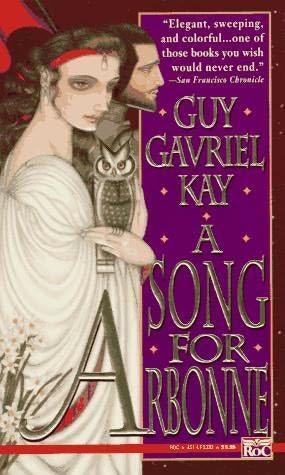
Arbonne is a lush, fertile land near the sea, and its people revere music and the Goddess Rian. In Gorhaut, the God Corannos and war are the only considerations. These two countries are on a collision course, which ends in a war where brother fight father — and a life-long friendship ends in death.
|
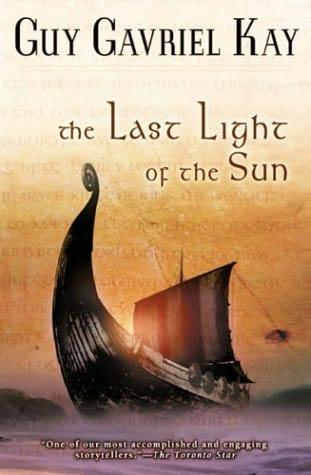
The Last Light of the Sun
From award-winning author Guy Gavriel Kay, who "stands among the world's finest fantasy authors" (Montreal Gazette), comes a sweeping tale evocative of the Celtic and Norse cultures of the ninth and tenth centuries, filled with the human passion and epic adventure he is noted for.
|
The Lions of Al-Rassan
For the inspiration for this novel, Guy Gavriel Kay has drawn on the conflicts in medieval Spain, including King Ferdinand's expulsion of the Jews and forced conversion of those who remained during the Inquisiton, and the fall of Granada to the Christians. In this tale, there are two moons looking over a planet which is home to the country of Esperana. The rulers are the Asharites, who worship the stars and who hail from the neighboring land of Al-Rassan. The Kindath, a dispersed people with no country of their own, worship the moons. The Horsemen of Jad are worshippers of the sun. Zealots from the Asharites and Jaddites are bent on taking advantage of the political turmoil in Esperana, and the central characters of the book do their best to keep civilization going.
|
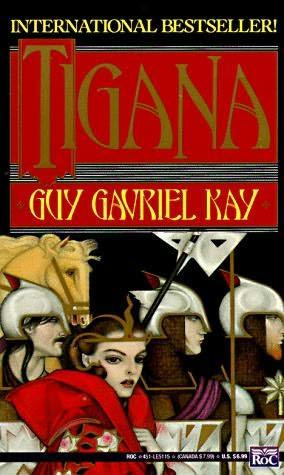
Tigana
"Tigana" is a land under the spell of the evil wizard Brandin, who has cast the spell to avenge the death of his son. Dianora has been sent to get close to the King of Tigana so that she may kill him and avenge the death of the wizard's son. However the King and Dianora fall in love.
|
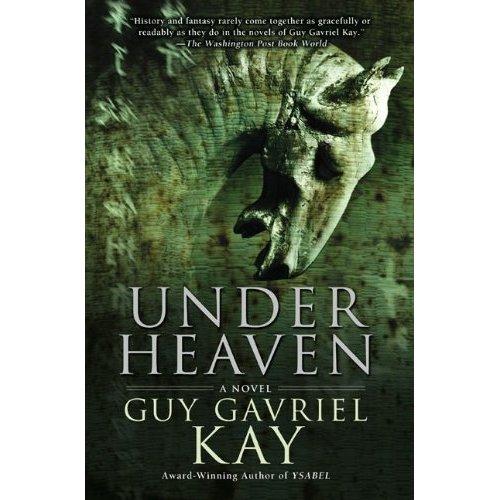
Under Heaven
Shen Tai, the second son of a renowned general of Kitai, is given a lavish gift of 250 prized Sardian horses from the Kitan Empress of the neighbouring Taguran Empire to honour his work burying the dead of both sides at a battleground in the far west of Kitai still haunted by the ghosts of the slain soldiers. This extraordinary gift threatens to engulf Shen Tai in the political and dynastic struggles that surround the throne of the Kitan Emperor, but also permits Shen Tai to form friendships and gain access to the most powerful figures in Kitai. Narrowly escaping an assassination attempt with the assistance of the ghosts of the unburied, Shen Tai leaves the battleground on the western frontier to journey toward the capital, Xinan, protected by Wei Song, a female Kanlin warrior. Another line of narrative follows Shen Tai's sister Li-Mei who is sent north to be married off to a leader of the northern Bogü for the purposes of advancing the career interests of Shen Liu, their older brother. Shen Tai must determine a way forward for himself, which involves making choices between personal, family and imperial needs, choices which become all the more perilous when Kitai is convulsed by a military rebellion that threatens the ruling dynasty. The story weaves themes of loss, chance, honour and friendship in a world still haunted by magic.
|
Under Heaven
An epic historical adventure set in a pseudo 8th century China, from the author of the 2008 World Fantasy winner, Ysabel. Under Heaven is a novel of heroes, assassins, concubines and emperors set against a majestic and unforgiving landscape.An epic historical adventure set in a pseudo 8th century China, from the author of the 2008 World Fantasy winner, Ysabel. Under Heaven is a novel of heroes, assassins, concubines and emperors set against a majestic and unforgiving landscape.For two years Shen Tai has mourned his father, living like a hermit beyond the borders of the Kitan Empire, by a mountain lake where terrible battles have long been fought between the Kitai and the neighbouring Tagurans, including one for which his father—a great general—was honoured. But Tai's father never forgot the brutal slaughter involved. The bones of 100,000 soldiers still lie unburied by the lake and their wailing ghosts at night strike terror in the living, leaving the lake and meadow abandoned in its ring of mountains.To honour and redress his father's sorrow, Tai has journeyed west to the lake and has laboured, alone, to bury the dead of both empires. His supplies are replenished by his own people from the nearest fort, and also—since peace has been bought with the bartering of an imperial princess—by the Tagurans, for his solitary honouring of their dead.The Tagurans soldiers one day bring an unexpected letter. It is from the bartered Kitan Princess Cheng-wan, and it contains a poisoned chalice: she has gifted Tai with two hundred and fifty Sardian horses, to reward him for his courage. The Sardians are legendary steeds from the far west, famed, highly-prized, long-coveted by the Kitans.
|
Ysabel
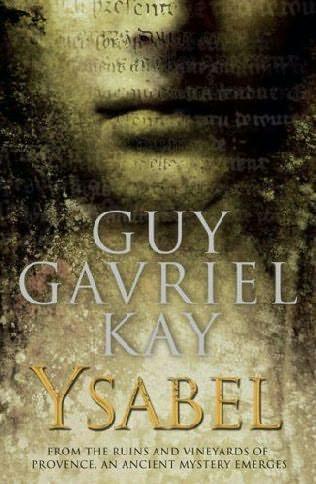
In this exhilarating, moving new work, Guy Gavriel Kay casts brilliant light on the ways in which history—whether of a culture or a family—refuses to be buried.Ned Marriner, fifteen years old, has accompanied his photographer father to Provence for a six-week «shoot» of images for a glossy coffee-table book. Gradually, Ned discovers a very old story playing itself out in this modern world of iPods, cellphones, and seven-seater vans whipping along roads walked by Celtic tribes and Roman legions.On one holy, haunted night of the ancient year, when the borders between the living and the dead are down and fires are lit upon the hills, Ned, his family, and his friends are shockingly drawn into this tale, as dangerous, mythic figures from conflicts of long ago erupt into the present, claiming and changing lives.
|