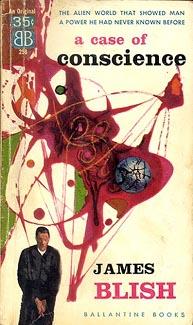
A Case of Conscience
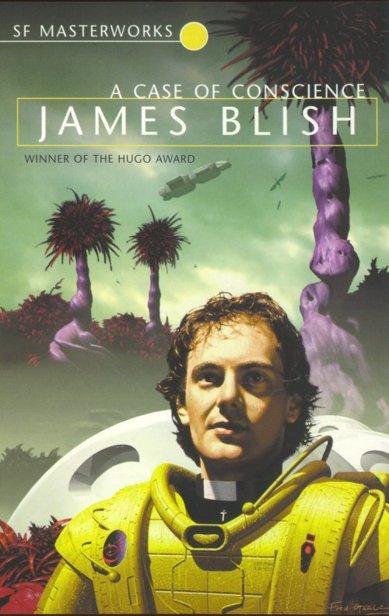
A Case of Conscience is a science fiction novel by James Blish, first published in 1958. It is the story of a Jesuit who investigates an alien race that has no religion; they are completely without any concept of God, an afterlife, or the idea of sin; and the species evolves through several forms through the course of its life cycle. The story was originally published as a novella in 1953, and later extended to novel-length, of which the first part is the original novella. The novel is the first part of Blish's thematic “After Such Knowledge” trilogy, followed by Black Easter/The Day After Judgment and Dr Mirabilis.The story is unusual in several respects. Few science fiction stories of the time attempted religious themes, and still fewer did this with Catholicism. Some of the first part is taken up with the Jesuit's attempt to solve a puzzle, a long description of scandalous intrigue between various pseudonymous characters. As he is about to leave for Earth, he realizes the puzzle is soluble. The puzzle is contained within the pages of Finnegans Wake, by James Joyce.Many reacted negatively to the story, but surprisingly few educated Catholics were among them. One even sent James Blish a copy of the actual Church guidelines for dealing with extraterrestrials. These are not detailed, but merely suggest overall strategy based on whether the beings have souls or not, and if they have them, whether they are fallen like humans, or exist in a state of grace.Won Hugo Award for Best Novel in 1959.
|
A Case of Conscience
A Case of Conscience is a science fiction novel by James Blish, first published in 1958. It is the story of a Jesuit who investigates an alien race that has no religion; they are completely without any concept of God, an afterlife, or the idea of sin; and the species evolves through several forms through the course of its life cycle. The story was originally published as a novella in 1953, and later extended to novel-length, of which the first part is the original novella. The novel is the first part of Blish's thematic "After Such Knowledge" trilogy, followed by Black Easter/The Day After Judgment and Dr Mirabilis.The story is unusual in several respects. Few science fiction stories of the time attempted religious themes, and still fewer did this with Catholicism. Some of the first part is taken up with the Jesuit's attempt to solve a puzzle, a long description of scandalous intrigue between various pseudonymous characters. As he is about to leave for Earth, he realizes the puzzle is soluble. The puzzle is contained within the pages of Finnegans Wake, by James Joyce.Many reacted negatively to the story, but surprisingly few educated Catholics were among them. One even sent James Blish a copy of the actual Church guidelines for dealing with extraterrestrials. These are not detailed, but merely suggest overall strategy based on whether the beings have souls or not, and if they have them, whether they are fallen like humans, or exist in a state of grace.Won Hugo Award for Best Novel in 1959.
|
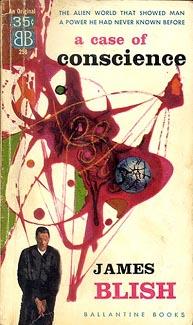
Case of Conscience
Father Ruiz-Sanchez is a dedicated man—a priest who is also a scientist, and a scientist who is also a human being. He has found no insoluble conflicts in his beliefs or his ethics… until he is sent to Lithia. There he comes upon a race of aliens who are admirable in every way except for their total reliance on cold reason; they are incapable of faith or belief.Confronted with a profound scientific riddle and ethical quandary, Father Ruiz-Sanchez soon finds himself torn between the teachings of his faith, the teachings of his science, and the inner promptings of his humanity. There is only one solution: He must accept an ancient and unforgivable heresy—and risk the futures of both worlds…Amazon.com ReviewThe citizens of the planet Lithia are some of the most ethical sentient beings Father Ramon Ruiz-Sanchez has ever encountered. True, they have no literature, no fine arts, and don’t understand the concept of recreation, but neither do they understand the concepts of greed, envy, lust, or any of the sins and vices that plague humankind. Their world seems darned near perfect. And that is just what disturbs the good Father.First published in 1958, James Blish’s Hugo Award-winning A Case of Conscience is science fiction at its very best: a fast-paced, intelligent story that offers plenty of action while at the same time explores complex questions of values and ethics. In this case, Blish has taken on the age-old battle of good vs. evil. Lithia poses a theological question that lies at the heart of this book: is God necessary for a moral society? The Lithians are nothing if not moral. Not only do they lack the seven deadly sins, they also lack original sin. And without any sort of religious framework, they have created the Christian ideal world, one that humans would be eager to study and emulate. But is it too perfect? Is it in fact, as Father Ruiz-Sanchez suspects, the work of The Adversary? And what role does Egtverchi, the young Lithian raised on Earth, play? Is he an innocent victim of circumstance, or will he bring about the Dies Irae, the day of the wrath of God, upon the earth? The fate of two worlds hinges on the answers to these questions, and will lead to an ancient earth heresy that shakes the Jesuit priest’s beliefs to their very core.A Case of Conscience is a brilliant piece of storytelling, and it packs a lot into a scant 242 pages. Most readers will probably finish the book in one sitting, unable to stop until the spectacular denouement. But the questions posed by this little-known gem will stay with you for days afterward.—P. M. Atterberry
|
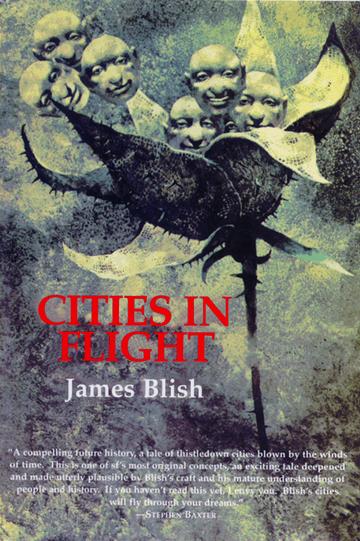
Cities in Flight
James Blish's galaxy-spanning masterwork, originally published in four volumes, explores a future in which two crucial discoveries ― antigravity devices which enable whole cities to be lifted from the Earth to become giant spaceships, and longevity drugs which enable their inhabitants to live for thousands of years ― lead to the establishment of a unique Galactic empire.
|
Der Hexenmeister
Titel der amerikanischen OriginalausgabeBLACK EASTER
|
Earthman, Come Home
|
Guerra al grande nulla
È possibile che gli altri mondi non siano abitati. Ma finora, niente esclude che possano invece ospitare forme di vita, simili o no alla nostra. Questo è un problema che le scoperte della nuova scienza rendono attuale e non più ignorabile, una questione che va considerata sotto tutti gli aspetti. Anche quello religioso. Infatti, fra i doveri della Chiesa c'è quello di mantenersi in linea coi tempi; e il punto a cui è arrivata la giovane scienza spaziale ha spinto appunto la Chiesa a interessarsi dell'eventualità che esistano altri pianeti abitati. A questo proposito importanti esponenti del Clero hanno consentito a rispondere alle domande dei giornalisti, e il risultato delle speciali recenti interviste è stato ampiamente pubblicato su autorevoli quotidiani. Il romanzo che presentiamo in questo numero sembra scritto proprio in seguito alle ipotesi formulate da un Padre Gesuita nel corso del colloquio cui abbiamo accennato. E, guarda caso, a protagonista del suo romanzo, James Blish ha scelto un Gesuita. Il tema è ardito, e solo un autore intelligente, obiettivo, e abile come Blish lo poteva affrontare. Ne è uscito il racconto più eccitante che sia mai stato scritto nel campo della fantascienza. Un romanzo che i lettori di Urania non possono ignorare.Premio Hugo per miglior romanzo in 1959.
|