Brazil on the Move
John Dos Passos, the distinguished American novelist and historian has been personally interested in Brazil for the last fifteen years. He first visited the country in 1948, and returned again in 1956 and 1962. This book, which is based on his experiences in Brazil, presents the people and landscapes of a young country on the move.Here you will find several extraordinary reports on Brasilia, first in the planning stage, second in the wildly frantic period when it was a half-finished group of buildings, and, finally, as it appeared to Mr. Dos Passos in the summer of 1962 when it was at last beginning to function as a city. Here, too, is the story of Brazil's great road building program designed to unify the country, and of the political battles in this enormous country which totters on the verge of a Communist takeover.From traveling the length and breadth of the land and from interviewing all kinds of people: politicians like Carlos Lacerda and religious leaders like Bishop Sales, Mr. Dos Passos has been able to transmit some of the flavor of the most important of Latin American nations.Mr. Dos Passos himself is of Portuguese descent, and he speaks Portuguese as well as Spanish. He begins this readable and fascinating book with a much needed short sketch of the history of Brazil and how the Portuguese tradition differs from the Spanish in South America.
|
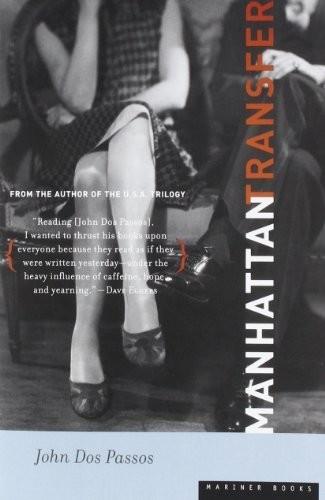
Manhattan transfer
Considered by many to be John Dos Passos’s greatest work, Manhattan Transfer is an “expressionistic picture of New York” (New York Times) in the 1920s that reveals the lives of wealthy power brokers and struggling immigrants alike. From Fourteenth Street to the Bowery, Delmonico’s to the underbelly of the city waterfront, Dos Passos chronicles the lives of characters struggling to become a part of modernity before they are destroyed by it.More than seventy-five years after its first publication, Manhattan Transfer still stands as “a novel of the very first importance” (Sinclair Lewis). It is a masterpeice of modern fiction and a lasting tribute to the dual-edged nature of the American dream.
|
Mr. Wilson's War
A dazzling work of American history from the author of the “U.S.A. trilogy”.Beginning with the assassination of McKinley and ending with the defeat of the League of Nations by the United States Senate, the twenty-year period covered by John Dos Passos in this lucid and fascinating narrative changed the whole destiny of America. This is the story of the war we won and the peace we lost, told with a clear historical perspective and a warm interest in the remarkable people who guided the United States through one of the most crucial periods.Foremost in the cast of characters is Woodrow Wilson, the shy, brilliant, revered, and misunderstood “schoolmaster”, whose administration was a complex of apparent contradictions. Wilson had almost no interest in foreign affairs when he was first elected, yet later, in proposing the League of Nations, he was to play a major role in international politics. During his first summer in office, without any…
|
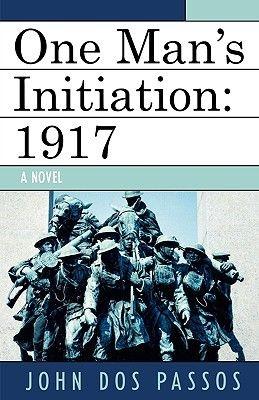
One Man's Initiation, 1917
Based on the author’s first-hand experience as an ambulance driver during World War I, this first novel is noteworthy for its vivid and colorful portrait of France at that time and for its passionate indictment of war. The author’s disillusionment with war, for a time, turned him toward socialism and against capitalism. Finally, after being labeled “pro-German” and “pacifist,” Dos Passos concluded that the quasi-religion of Marxism was far more brutal than “poor old Capitalism ever dreamed of.” Reprinted from the unexpurgated original edition published by Cornell University Press in 1969.
|
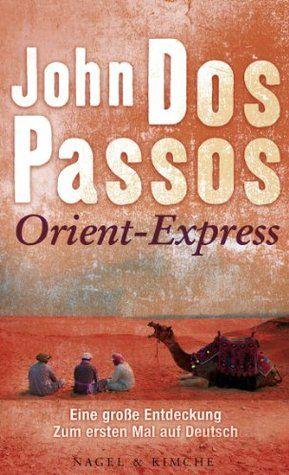
Orient-Express
1921 reiste der später weltberühmte Autor John Dos Passos durch den Orient – schon damals eine hochexplosive Gegend – und hielt seine Eindrücke in einem Tagebuch fest. Diese abenteuerliche Reise führte den damals 25-Jährigen von der Türkei über Georgien, Armenien, den Iran und den Irak bis nach Syrien. Sein packender Bericht liest sich wie eine Mischung aus Abenteuerroman und der hellsichtigen Analyse eines dramatischen Umbruchs, der bis heute fortwirkt. Geschrieben in knapper Präzision, mit ansteckender Neugier und Beobachtungsgabe, ist das Werk, mit dem Dos Passos dabei war, zu einem der wichtigsten Schriftsteller der amerikanischen Moderne zu werden, jetzt erstmals auf Deutsch zu entdecken.
|
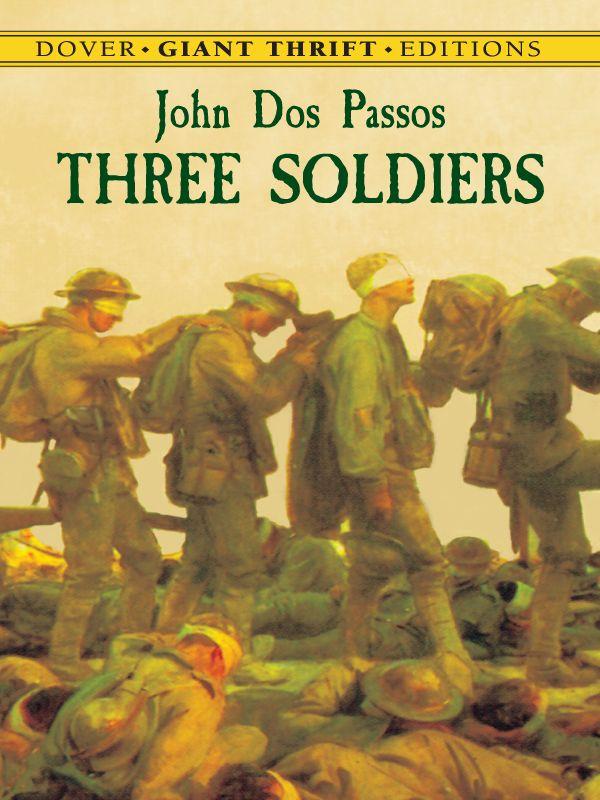
Three Soldiers
Part of the generation that produced Ernest Hemingway and Ford Madox Ford, John Dos Passos wrote one of the most grimly honest portraits of World War I. Three Soldiers portrays the lives of a trio of army privates: Fuselli, an Italian American store clerk from San Francisco; Chrisfield, a farm boy from Indiana; and Andrews, a musically gifted Harvard graduate from New York. Hailed as a masterpiece on its original publication in 1921, Three Soldiers is a gripping exploration of fear and ambition, conformity and rebellion, desertion and violence, and the brutal and dehumanizing effects of a regimented war machine on ordinary soldiers.
|