 fb2
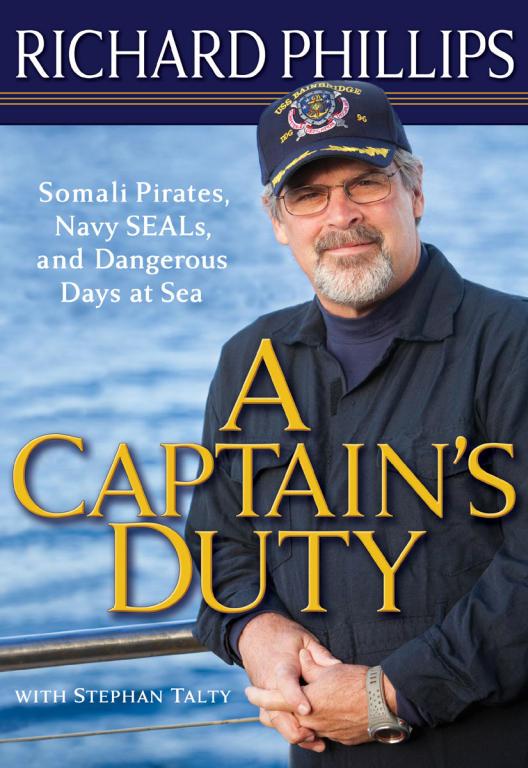
fb2It was just another day on the job for fifty-three-year-old Richard Phillips, captain of the Maersk Alabama, the United States-flagged cargo ship which was carrying, among other things, food and agricultural materials for the World Food Program. That all changed when armed Somali pirates boarded the ship. The pirates didn’t expect the crew to fight back, nor did they expect Captain Phillips to offer himself as hostage in exchange for the safety of his crew. Thus began the tense five-day stand-off, which ended in a daring high-seas rescue when U.S. Navy SEALs opened fire and picked off three of the captors.
“It never ends like this,” Captain Phillips said.
And he’s right.
A Captain’s Duty tells the life-and-death drama of the Vermont native who was held captive on a tiny lifeboat off Somalia’s anarchic, gun-plagued shores. A story of adventure and courage, it provides the intimate details of this high-seas hostage-taking—the unbearable heat, the death threats, the mock executions, and the escape attempt. When the pirates boarded his ship, Captain Phillips put his experience into action, doing everything he could to safeguard his crew. And when he was held captive by the pirates, he marshaled all his resources to ensure his own survival, withstanding intense physical hardship and an escalating battle of wills with the pirates. This was it: the moment where training meets instinct and where character is everything. Richard Phillips was ready.

In 2003 Kevin Sampsell authored a chapbook memoir of the same title. It was written as a kind of “memory experiment,” in which he recollected luminous details from his childhood in independently amusing chapters. It functioned as an experiential catalogue of American youth in the 70s and 80s.
In 2008 Kevin’s estranged father died of an aneurysm. When he returned home to Kennewick, Washington for the funeral, Kevin’s mother revealed to him disturbing threads in their family history—stories of incest, madness, betrayal, and death—which retroactively colored Kevin’s memories of his upbringing and youth. He learned of his mother’s first two husbands, the fathers of his three older, mythologized half-siblings, and the havoc they wreaked on his mother. He learned of his own father’s seething resentment of his step-children, which was expressed in physical, pyschological, and sexual abuse. And he learned more about his oldest step-sister, Elinda, who, as a young girl, was labeled “feebleminded” by a teacher. When she became a teenager, she was sent to a psychiatric hospital. She entered the clinic at 98 pounds. She left two years later 200 pounds, diabetic, having endured numerous shock treatments. Then, after finally returning home, she was made pregnant by Kevin’s father. Only at the end of the book do we learn what chance in life a person like this has.
While his family’s story provides the framework of the book, what’s left in between is Kevin’s story of growing up in the Pacific Northwest. He tells of his first jobs, first bands, first loves, and one worn, teal blue suitcase filled with the choicest porn in all of Kennewick, Washington.
Employing the same form of memoir as he did in his previous book, Kevin intertwines the tragic with the everyday, the dysfunctional with the fun, lending A COMMON PORNOGRAPHY its undeniable, unsensationalized reality. The elastic conceit of his “memory experiment” captures the many shades and the whole of the Sampsell family—both its tragedy and its resiliency. Kevin relates this history in a charming, honest, insightful, and funny voice.

In 2003 Kevin Sampsell authored a chapbook memoir of the same title. It was written as a kind of “memory experiment,” in which he recollected luminous details from his childhood in independently amusing chapters. It functioned as an experiential catalogue of American youth in the 70s and 80s.
In 2008 Kevin’s estranged father died of an aneurysm. When he returned home to Kennewick, Washington for the funeral, Kevin’s mother revealed to him disturbing threads in their family history—stories of incest, madness, betrayal, and death—which retroactively colored Kevin’s memories of his upbringing and youth. He learned of his mother’s first two husbands, the fathers of his three older, mythologized half-siblings, and the havoc they wreaked on his mother. He learned of his own father’s seething resentment of his step-children, which was expressed in physical, pyschological, and sexual abuse. And he learned more about his oldest step-sister, Elinda, who, as a young girl, was labeled “feebleminded” by a teacher. When she became a teenager, she was sent to a psychiatric hospital. She entered the clinic at 98 pounds. She left two years later 200 pounds, diabetic, having endured numerous shock treatments. Then, after finally returning home, she was made pregnant by Kevin’s father. Only at the end of the book do we learn what chance in life a person like this has.
While his family’s story provides the framework of the book, what’s left in between is Kevin’s story of growing up in the Pacific Northwest. He tells of his first jobs, first bands, first loves, and one worn, teal blue suitcase filled with the choicest porn in all of Kennewick, Washington.
Employing the same form of memoir as he did in his previous book, Kevin intertwines the tragic with the everyday, the dysfunctional with the fun, lending A COMMON PORNOGRAPHY its undeniable, unsensationalized reality. The elastic conceit of his “memory experiment” captures the many shades and the whole of the Sampsell family—both its tragedy and its resiliency. Kevin relates this history in a charming, honest, insightful, and funny voice.
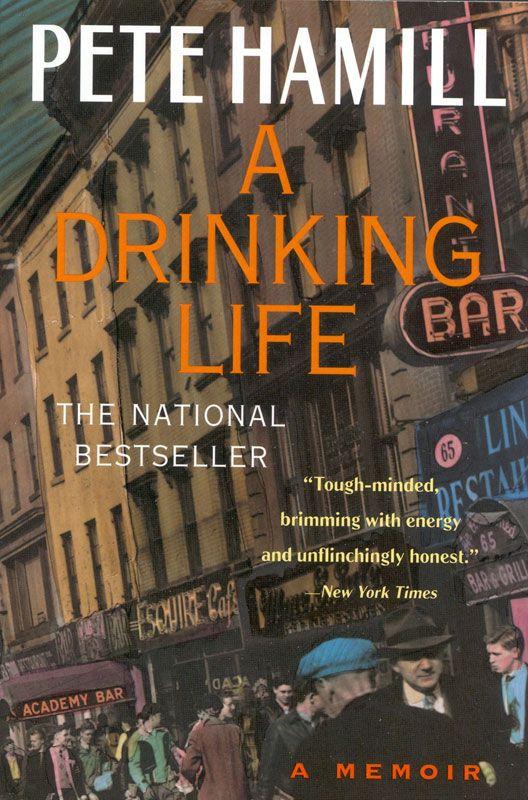
As a child during the Depression and World War II, Pete Hamill learned early that drinking was an essential part of being a man, inseparable from the rituals of celebration, mourning, friendship, romance, and religion. Only later did he discover its ability to destroy any writer's most valuable tools: clarity, consciousness, memory. In *A Drinking Life*, Hamill explains how alcohol slowly became a part of his life, and how he ultimately left it behind. Along the way, he summons the mood of an America that is gone forever, with the bittersweet fondness of a lifelong New Yorker.
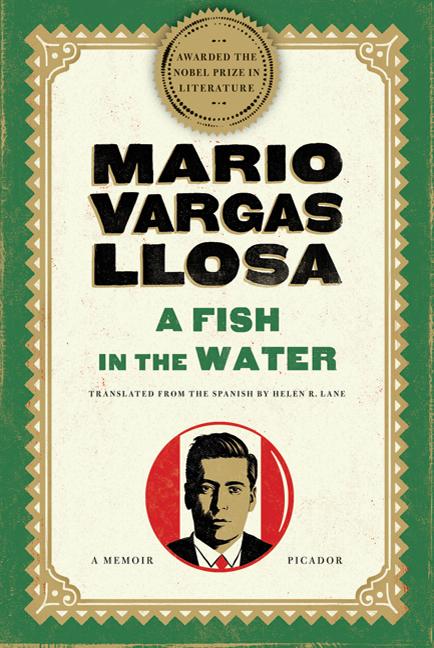
Mario Vargas Llosa's A Fish in the Water is a twofold book: a memoir of one of Latin America's most celebrated witers, beginning with his birth in 1936 in Arequipa, Peru; and the story of his organization of the reform movement which culminated in his bid for the Peruvian presidency in 1990.

Ernst Jünger, one of twentieth-century Germany’s most important and controversial writers, faithfully kept a journal during the Second World War in occupied Paris, on the eastern front, and in Germany until its defeat-writings that are of major historical and literary significance. These wartime journals appear here in English for the first time.
Ernst Jünger was one of twentieth-century Germany’s most important—and most controversial—writers. Decorated for bravery in World War I and the author of the acclaimed western front memoir Storm of Steel, he frankly depicted war’s horrors even as he extolled its glories. As a Wehrmacht captain during World War II, Jünger faithfully kept a journal in occupied Paris and continued to write on the eastern front and in Germany until its defeat—writings that are of major historical and literary significance. Jünger’s Paris journals document his Francophile excitement, romantic affairs, and fascination with botany and entomology, alongside mystical and religious ruminations and trenchant observations on the occupation and the politics of collaboration. While working as a mail censor, he led the privileged life of an officer, encountering artists such as Céline, Cocteau, Braque, and Picasso. His notes from the Caucasus depict the chaos after Stalingrad and atrocities on the eastern front. Upon returning to Paris, Jünger observed the French resistance and was close to the German military conspirators who plotted to assassinate Hitler in 1944. After fleeing France, he reunited with his family as Germany’s capitulation approached.
Both participant and commentator, close to the horrors of history but often distancing himself from them, Jünger turned his life and experiences into a work of art. These wartime journals appear here in English for the first time, giving fresh insights into the quandaries of the twentieth century from the keen pen of a paradoxical observer.
Ernst Jünger (1895–1998) was a major figure in twentieth-century German literature and intellectual life. He was a young leader of right-wing nationalism in the Weimar Republic. Among his many works is the novel On the Marble Cliffs, a symbolic criticism of totalitarianism written under the Third Reich.
Elliot Neaman is professor of history at the University of San Francisco and the author of A Dubious Past: Ernst Jünger and the Politics of Literature after Nazism (1999).
Thomas Hansen, a longtime member of the Wellesley College German Department, is a translator from the German.
Abby Hansen is a translator of German literary and nonfiction texts.

Winner of the 2007 National Jewish Book Award in the category of Biography, Autobiography & Memoir.
A powerful memoir of war, politics, literature, and family life by one of Europe's leading intellectuals.
When George Konrad was a child of eleven, he, his sister, and two cousins managed to flee to Budapest from the Hungarian countryside the day before deportations swept through his home town. Ultimately, they were the only Jewish children of the town to survive the Holocaust.
A Guest in My Own Country recalls the life of one of Eastern Europe's most accomplished modern writers, beginning with his survival during the final months of the war. Konrad captures the dangers, the hopes, the betrayals and courageous acts of the period through a series of carefully chosen episodes that occasionally border on the surreal (as when a dead German soldier begins to speak, attempting to justify his actions).
The end of the war launches the young man on a remarkable career in letters and politics. Offering lively descriptions of both his private and public life in Budapest, New York, and Berlin, Konrad reflects insightfully on his role in the Hungarian Uprising, the notion of "internal emigration" — the fate of many writers who, like Konrad, refused to leave the Eastern Bloc under socialism — and other complexities of European identity. To read A Guest in My Own Country is to experience the recent history of East-Central Europe from the inside.
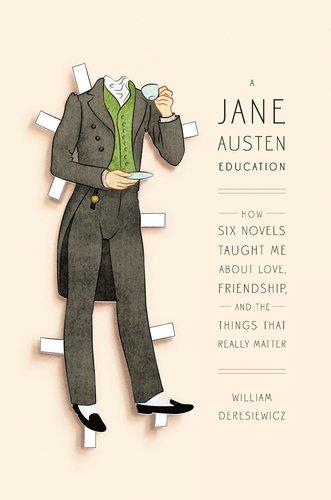
In A Jane Austen Education, Austen scholar William Deresiewicz turns to the author's novels to reveal the remarkable life lessons hidden within. With humor and candor, Deresiewicz employs his own experiences to demonstrate the enduring power of Austen's teachings. Progressing from his days as an immature student to a happily married man, Deresiewicz's A Jane Austen Education is the story of one man's discovery of the world outside himself.
A self-styled intellectual rebel dedicated to writers such as James Joyce and Joseph Conrad, Deresiewicz never thought Austen's novels would have anything to offer him. But when he was assigned to read Emma as a graduate student at Columbia, something extraordinary happened. Austen's devotion to the everyday, and her belief in the value of ordinary lives, ignited something in Deresiewicz. He began viewing the world through Austen's eyes and treating those around him as generously as Austen treated her characters. Along the way, Deresiewicz was amazed to discover that the people in his life developed the depth and richness of literary characters-that his own life had suddenly acquired all the fascination of a novel. His real education had finally begun.
Weaving his own story-and Austen's-around the ones her novels tell, Deresiewicz shows how her books are both about education and themselves an education. Her heroines learn about friendship and feeling, staying young and being good, and, of course, love. As they grow up, they learn lessons that are imparted to Austen's reader, who learns and grows by their sides.
A Jane Austen Education is a testament to the transformative power of literature, a celebration of Austen's mastery, and a joy to read. Whether for a newcomer to Austen or a lifelong devotee, Deresiewicz brings fresh insights to the novelist and her beloved works. Ultimately, Austen's world becomes indelibly entwined with our own, showing the relevance of her message and the triumph of her vision.

A poignant, intimate, funny, inspiring memoir—both a coming-of-age story and a meditation on creativity, devotion, and craft—from Bryan Cranston, beloved and acclaimed star of one of history’s most successful TV shows, Breaking Bad.
Bryan Cranston landed his first role at seven, when his father cast him in a United Way commercial. Acting was clearly the boy’s destiny, until one day his father disappeared. Destiny suddenly took a backseat to survival.
Now, in his riveting memoir, Cranston maps his zigzag journey from abandoned son to beloved star by recalling the many odd parts he’s played in real life—paperboy, farmhand, security guard, dating consultant, murder suspect, dock loader, lover, husband, father. Cranston also chronicles his evolution on camera, from soap opera player trying to master the rules of show business to legendary character actor turning in classic performances as Seinfeld dentist Tim Whatley, “a sadist with newer magazines,” and Malcolm in the Middle dad Hal Wilkerson, a lovable bumbler in tighty-whities. He also gives an inspiring account of how he prepared, physically and mentally, for the challenging role of President Lyndon Johnson, a tour de force that won him a Tony to go along with his four Emmys.
Of course, Cranston dives deep into the grittiest details of his greatest role, explaining how he searched inward for the personal darkness that would help him create one of the most memorable performances ever captured on screen: Walter White, chemistry teacher turned drug kingpin.
Discussing his life as few men do, describing his art as few actors can, Cranston has much to say about creativity, devotion, and craft, as well as innate talent and its challenges and benefits and proper maintenance. But ultimately A Life in Parts is a story about the joy, the necessity, and the transformative power of simple hard work.
A New York Times Notable Book of the Year
A Time Magazine Best Book of the Year
A Newsweek Favorite Book of the Year
A Quill Book Award Finalist
A Christian Science Monitor Best Book of the Year
A YALSA Best Book for Young Adults
Winner of the Alex Award
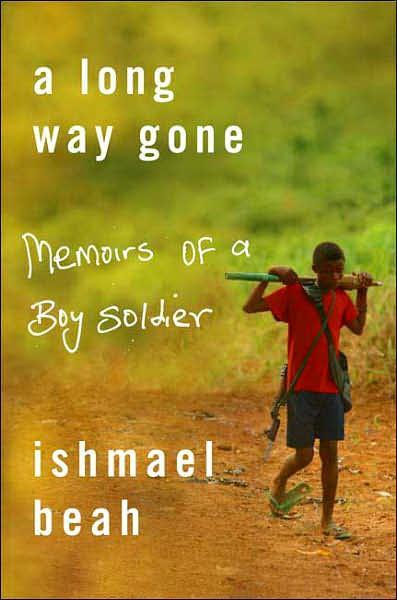
This is how wars are fought now: by children, hopped-up on drugs and wielding AK-47s. Children have become soldiers of choice. In the more than fifty conflicts going on worldwide, it is estimated that there are some 300,000 child soldiers. Ishmael Beah used to be one of them.What is war like through the eyes of a child soldier? How does one become a killer? How does one stop? Child soldiers have been profiled by journalists, and novelists have struggled to imagine their lives. But until now, there has not been a first-person account from someone who came through this hell and survived.
In A Long Way Gone, Beah, now twenty-five years old, tells a riveting story: how at the age of twelve, he fled attacking rebels and wandered a land rendered unrecognizable by violence. By thirteen, he had been picked up by the government army, and Beah, at heart a gentle boy, found that he was capable of truly terrible acts. At sixteen, he was removed from fighting by UNICEF, and through the help of the staff at his rehabilitation center, he learned how to forgive himself, to regain his humanity, and finally, to heal. This is a rare and mesmerizing account, told with real literary force and heartbreaking honesty.
Also available on CD as an unabridged audiobook, read by the author. Please email academic@macmillan.com for more information.

THE STORY OF A GREAT AMERICAN BUILDER
At the peak of his power, in the 1940s and 1950s, William Francis Gibbs was considered America’s best naval architect. His quest to build the finest, fastest, most beautiful ocean liner of his time, the S.S. United States, was a topic of national fascination. When completed in 1952, the ship was hailed as a technological masterpiece at a time when “made in America” meant the best.
Gibbs was an American original, on par with John Roebling of the Brooklyn Bridge and Frank Lloyd Wright of Fallingwater. Forced to drop out of Harvard following his family’s sudden financial ruin, he overcame debilitating shyness and lack of formal training to become the visionary creator of some of the finest ships in history. He spent forty years dreaming of the ship that became the S.S. United States.
William Francis Gibbs was driven, relentless, and committed to excellence. He loved his ship, the idea of it, and the realization of it, and he devoted himself to making it the epitome of luxury travel during the triumphant post–World War II era. Biographer Steven Ujifusa brilliantly describes the way Gibbs worked and how his vision transformed an industry. A Man and His Ship is a tale of ingenuity and enterprise, a truly remarkable journey on land and sea.
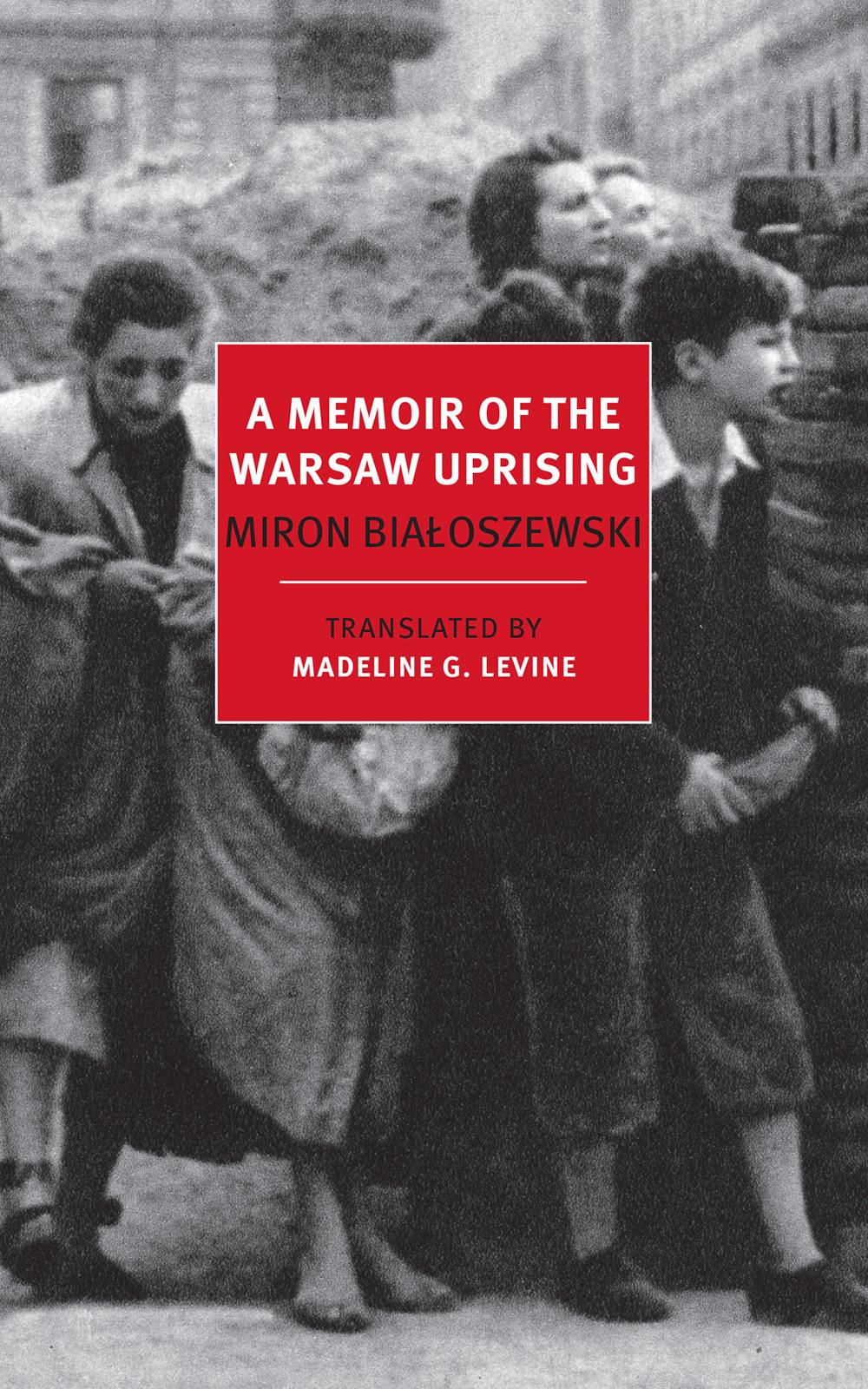
This book is both a work of memory and a work about memory. Miron Bialoszewski (1922-83), the great avant-garde Polish poet, memorializes the doomed uprising of the Polish population against their Nazi masters which began on August 1, 1944, and was eventually abandoned on October 2, 1944, with the physical destruction of Warsaw, street by street and house by house, and the slaughter of 200,000 civilians.

Elena Gorokhova’s A Mountain of Crumbs is the moving story of a Soviet girl who discovers the truths adults are hiding from her and the lies her homeland lives by. Elena’s country is no longer the majestic Russia of literature or the tsars, but a nation struggling to retain its power and its pride. Born with a desire to explore the world beyond her borders, Elena finds her passion in the complexity of the English language—but in the Soviet Union of the 1960s such a passion verges on the subversive. Elena is controlled by the state the same way she is controlled by her mother, a mirror image of her motherland: overbearing, protective, difficult to leave. In the battle between a strong-willed daughter and her authoritarian mother, the daughter, in the end, must break free and leave in order to survive.
Through Elena’s captivating voice, we learn not only the stories of Russian family life in the second half of the twentieth century, but also the story of one rebellious citizen whose curiosity and determination finally transport her to a new world. It is an elegy to the lost country of childhood, where those who leave can never return.
Moving, honest and inspiring – this is a nurse’s story of life in a busy A &E department during the Covid-19 crisis.
Working in A&E is a challenging job but nurse Louise Curtis loves it. She was newly qualified as an advanced clinical practitioner, responsible for life or death decisions about the patients she saw, when the unthinkable happened and the country was hit by the Covid-19 pandemic. The stress on the NHS was huge and for the first time in her life, the job was going to take a toll on Louise herself.
In A Nurse’s Story she describes what happened next, as the trickle of Covid patients became a flood. And just as tragically, staff in A&E were faced with the effects of lockdown on society. They worried about their regulars, now missing, and saw an increase in domestic abuse victims and suicide attempts as loneliness hit people hard. By turns heartbreaking and heartwarming, this book shines a light on the compassion and dedication of hospital staff during such dark times.
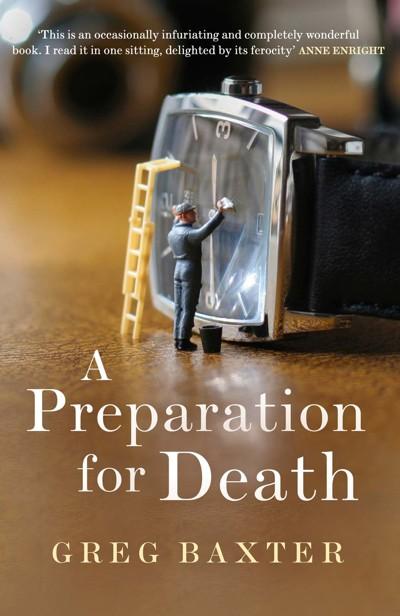
In his early thirties, Greg Baxter found himself in a strange place. He hated his job, he was drinking excessively, he was sabotaging his most important relationships, and he was no longer doing the thing he cared about most: writing. Strangest of all, at this time he started teaching evening classes in creative writing — and his life changed utterly.
A Preparation for Death is a document of the chaos and discovery of that time and of the experiences that led Greg Baxter to that strange place — an extraordinarily intimate account of literary failure (and its consequences), personal decay, and redemption through reading, writing, and truth-telling.
'Brilliant and wonderfully original… Yes, this is a book about drinking and shagging. But rarely have these things been written about so well' William Leith, Literary Review
'Baxter is a serious, thoughtful writer, bend on emotional truth and artistry. He has written an unusual, provocative book' Suzi Feay, Financial Times
'Brave, honest and propulsive' Metro
'The triumph is the steely courage it takes to put a life down with such uncompromising clarity' Hugo Hamilton, Irish Times
'This is an occasionally infuriating and completely wonderful book. I read it in one sitting, unsettled and delighted by its ferocity' Anne Enright
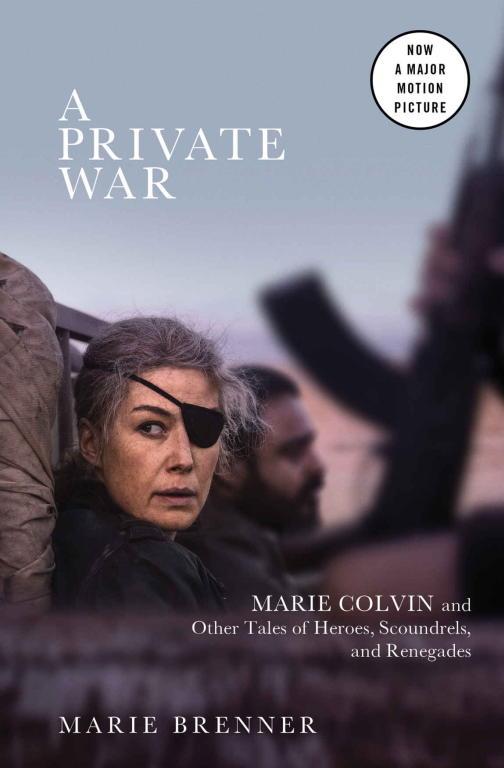
Now a major motion picture starring Rosamund Pike, Stanley Tucci, and Jamie Dornan, A Private War is the story of legendary war correspondent Marie Colvin, who died in 2012 while covering the Syrian civil war.
In February 2012, Marie Colvin crossed into Syria on the back of a motorcycle. A veteran war correspondent known for her fearlessness, outspokenness, and signature eye patch, she was defying a government decree preventing journalists from entering the country. Accompanied by photographer Paul Conroy, she was determined to report on the Syrian civil war, adding to a long list of conflicts she had covered, including those in Egypt, Chechnya, Kosovo, and Libya. She had witnessed grenade attacks, saved more than one thousand women and children in an East Timor war zone when she refused to stop reporting until they were evacuated, and even interviewed Muammar Qaddafi. But she had no idea that the story she was looking for in Syria would be her last, culminating in the explosion of an improvised device that sent shock waves across the world.
In A Private War, Marie Brenner brilliantly chronicles the last days and hours of Colvin’s life, moment by moment, to share the story of a remarkable life lived on the front lines. This collection also includes Brenner’s classic encounters with Donald Trump, Roy Cohn, Malala Yousafzai, Richard Jewell, and others.
‘I could see that still no one had been able to get out from the cockpit. It must have been at this moment that I thought I was going to die because I became remarkably calm.’
Trapped inside a burning Lancaster bomber, 20,000 feet above Berlin, airman John Martin consigned himself to his fate and turned his thoughts to his fiancée back home. In a miraculous turn of events, however, the twenty-one year old was thrown clear of his disintegrating aeroplane and found himself parachuting into the heart of Nazi Germany. He was soon to be captured and began his period as a prisoner of war.
This engaging and compulsively readable true-life account of a Second World War airman, who cheated death in the sky, only to face interrogation and the prospect of being shot by the Gestapo, before having to endure months of hardship as a prisoner of war.

История восстания индейцев Сиу в 1862 году, рассказанная Большим Орлом (Вамди Танка)
This story is a personal account of my life with a sociopath beside me, a journey which takes you inside his mind and inside his darkness.
A Sociopath Beside Me is a true story about my life with a sociopath and the devastating circumstances he created for his many victims. This personal journey leads to the discovery that a sociopath was in our midst, examines his dishonorable behaviors, uncovers his hidden secret agendas, and validates the suffering of his victims.
The mission of this book is to give the reader the needed tools to recognize the sociopath who walks among us, so that we might avoid becoming their next unsuspecting victim.
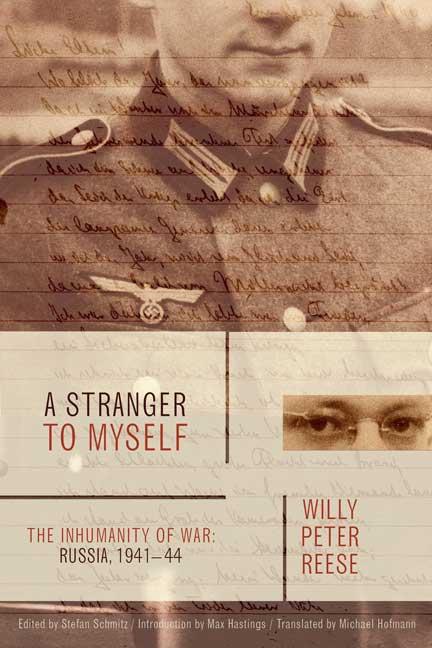
A Stranger to Myself: The Inhumanity of War, Russia 1941-44 is the haunting memoir of a young German soldier on the Russian front during World War II. Willy Peter Reese was only twenty years old when he found himself marching through Russia with orders to take no prisoners. Three years later he was dead. Bearing witness to—and participating in—the atrocities of war, Reese recorded his reflections in his diary, leaving behind an intelligent, touching, and illuminating perspective on life on the eastern front. He documented the carnage perpetrated by both sides, the destruction which was exacerbated by the young soldiers’ hunger, frostbite, exhaustion, and their daily struggle to survive. And he wrestled with his own sins, with the realization that what he and his fellow soldiers had done to civilians and enemies alike was unforgivable, with his growing awareness of the Nazi policies toward Jews, and with his deep disillusionment with himself and his fellow men.
An international sensation, A Stranger to Myself is an unforgettable account of men at war.